CENTRE DE RECHERCHE SUR LA MONDIALISATION The deep politics of regime
removal in Iraq : Overt conquest, covert operations BY LARRY CHIN vendredi
20 décembre 2002,
As
this report goes to press, a new round of UN "weapons inspections" has
begun. This charade, designed to create the appearance of an international
consensus, will delay, but not stop, the American rampage. In absence of
suitable evidence implicating Iraq, evidence will be produced. In the absence of
justifications, new pretexts will be manufactured, and old ones, dusted off and
repeated. The head of UN inspections, Hans Blix, the man entrusted with deciding
whether Iraq is harboring weapons of mass destruction, "cannot guarantee
that his inspection teams does not include Western spies". Complete
text. Originally published as a five-part series (October 24-November 22, 2002)
I Into the abyss The Bush administration is putting the finishing touches on an
invasion of Iraq, and possibly Saudi Arabia, Iran and beyond. The next phase of
the long-planned and sequential 9/11 War will involve the removal of Saddam
Hussein, and either the installation of a new puppet regime or US military
occupation, or the takeover and partitioning of Iraqi territory by US surrogates
(Jordan, Kuwait and the Kurds). This report will attempt to explain the means by
which Iraq is likely to fall, the groups and individuals who will carry it out,
and the various hidden agendas that the mainstream media have refused to
analyze, much less report. The Middle East : the 9/11 War's key prize
"Regime change," the criminal toppling of sovereign nations, has been
casually bandied about by the Bush administration and the US media for months,
but it is hardly news. The Iraq Liberation Act, which was passed by the US
Congress and signed into law in 1998, explicitly calls for regime change.
Washington's predatory interest in Iraq is bluntly stated by the President's
National Security Strategy : "The purpose of US engagement, as espoused in
the NSS is to protect the United States' vital interest in the
region---uninterrupted, secure US/Allied access to Gulf oil."
www.milnet.com/pentagon/centcom/chap1/stratgic.htm#USPolicy Additionally, the
"easing of US access to Persian Gulf supplies" is a priority stated in
the US National Energy Policy Report of 2001-the notorious "Cheney
Report". In the short-term, the Bush administration's goal is to break the
back of OPEC, head off an impending crash of the US oil industry, and rescue a
plundered US economy that is on the verge of collapse. Capturing Iraq would
accomplish this. As reported by Ed Vulliamy, Paul Webster and Nick Paton Walsh
in The Observer (10/6/02), "The current high price of oil is dragging the
US economy further into recession. US control of the Iraqi reserves, perhaps the
biggest unmapped reservoir in the world, would break Saudi Arabia's hold on the
oil-pricing cartel OPEC, and dictate prices for the next century."
Washington insiders have not bothered to disguise their blood-for-oil zeal.
Lawrence Lindsey, George W. Bush's economic adviser, said, "When there is a
regime change in Iraq, you could add 3 million to 5 million barrels of
production to world supply. The successful prosecution of the war would be good
for the economy." Former CIA Director James Woolsey echoed this sentiment :
"Iraq is exporting only 1 million barrels of oil a day, and that under US
occupation, output could be increased by 3 to 4 million barrels a day as a price
control measure." Another former CIA operative, Reuel Marc Gerecht, a
fellow at the American Enterprise Institute, added, "OPEC is already
significantly fractured, and US control of Iraq oil would already add to its
internal frictions. It would definitely diminish the Saudis' influence (over the
United States) and would cause the Iranian regime a lot of trouble." The
Big Rollover The true long-term agenda driving the planned Middle East operation
is the pursuit of the largest remaining reserves of oil in a world running out
of oil. This nightmarish scientific fact, which has been well understood by the
world's elites, has been studiously kept from the public. (See www.dieoff.com )
As explained in a series of reports by Dale Allen Pfeiffer, geologist and
Contributing Editor for Energy for From the Wilderness, "based on the
Hubbert Curve (a standard measure of world oil production peaks and declines),
in five years, we will no longer be able to produce enough oil to meet the needs
of our oil civilization." The Background is Oil What Will Be the Next
Target of the Oil Coup ? Is the Empire About Oil ? Is China the Endgame for Oil
? http://www.fromthewilderness.com/free/ww3/102302_campbell.html Professor
Richard Heinberg, editor of The Museletter writes : "After that 'Big
Rollover,' as one USGS geophysicist has dubbed it, there will be a few
percentage points less oil available each year to meet the rising world demand,
regardless of what anyone does." In the context of this looming cataclysm,
the Bush administration's sequential capture of the world's major oil supplies
(Central Asia, Middle East, Balkans, Venezuela, Colombia, South China Sea,
etc.), under the pretext of a "war on terrorism", is as predictable as
it is brazen : Iraq has 113 billion barrels of proven oil reserves, second
worldwide only to Saudi Arabia. Iraq controls 11 percent of the oil on the
planet. The US Department of Energy estimates that Iraq has as much as 220
billion barrels in undiscovered reserves. There are 70 known oil fields in Iraq,
only 15 of which have been developed. Saudi Arabia, which is on the brink of
civil war, and a convenient simultaneous target of a US conquest, owns another
25 percent of the world's oil supply. "Together the two countries, which
have not yet peaked in production capacity, and which are the only two nations
capable of an immediate increase in output, possess 36 percent of the world's
known oil" according to Michael C. Ruppert (From the Wilderness , 8/12/02)
Michael Klare, author of The Resource Wars, adds : "Iraq is the only
country besides Saudi Arabia that can add millions of barrels per day in
additional production over the next 10 to 20 years." "In the coming
years," writes Pfeiffer, "continued US hegemony will depend upon
maintaining control and access to the world's dwindling hydrocarbon reserves,
most of which are contained in the Middle East." And the oil elite, led by
the Bush administration, will stop at nothing to secure the remaining riches and
dictate their use. Against this canvass of global crisis, the explicit policy of
the US towards Iraq has been regime change, a process first begun under the
George H.W. Bush administration. As noted by Joe Taglieri (From the Wilderness
10/1/02), a close-knit cabal of current and former White House officials and
hawkish war planners affiliated with conservative think tanks has been
developing strategies for removing the Iraqi regime since 1991. In the most
recent plan penned by Dick Cheney and Paul Wolfowitz, and reported by Stratfor ,
Iraq will disappear, and the nation itself will be split into three parts . The
central part of Iraq, currently populated by the Sunni Arabs, would become part
of Jordan and ruled by Jordanian King Abdullah. The Kurdish region of northern
and northwestern Iraq, including Mosul and the vast Kirkuk oilfields, would
become an autonomous state. Southwestern Iraq would become a part of Kuwait.
Another Washington blueprint reported in the Wall Street Journal (11/12/02)
involves a plan similar to post-World War II Japan---a military occupation
headed by an American and assisted by US-allied Iraqi exiles and technocrats.
Based on lists produced by Iraqi opposition operatives, current Ba'ath Party
officials would be tried as war criminals. As evidenced by the establishment of
new permanent military bases throughout the Middle East and Central Asia, and
new long-term war appropriations (such as a five-year contract signed on August
5, 2002, between the US Navy and Maersk Shipping Line to operate vessels to
ferry tanks, ammunition and other weaponry from Diego Garcia to the Persian
Gulf), the US appears committed to a major Middle East conflict . The region is
completely encircled by US forces, which continue to be built up on a daily
basis. According to Reuters, "Washington believes that if US forces were to
attack Iraq the best conditions would be in the first few months of next
year." The fully complicit US Congress has already "rubber
stamped" the war. Intransigence from certain members of the United Nations
will delay but not likely stop it, as back-door deals continue to be negotiated
over the parceling of the post-Saddam spoils. Fronting for the Masters It is no
surprise that the "unsavory" regimes of Jordan, Kuwait and Turkey are
assisting the US effort. The ruling Jordanian monarchy has been closely
connected to Washington for decades. The late Jordanian King Hussein enjoyed a
relationship with the CIA going back to the 1950s. The current Jordanian regime
was installed by the United States. According to the Guardian (2/17/99),
"at the beginning of 1999, a combination of CIA manipulation, palace
intrigue and pressure from Hussein's American wife, Queen Noor, resulted in
long-time Crown Prince Hassan being dumped in favor of Abdullah, son of
Hussein's British wife and commander of Jordan's Special Forces. And so,
Abdullah II becomes King of the Hashemite Kingdom of Jordan". Jordan is
also the headquarters of the CIA-connected Iraqi National Accord, one of the
preferred Iraqi opposition groups. Similarly, the Kuwaiti regime, headed by the
al Sabbah family, is also deeply tied to Washington and the Bush family. It was
Kuwait's slant-drilling into Iraq, coupled with George H.W. Bush's numerous
provocations (including an international oil price-fixing scheme) that baited
Saddam Hussein to invade Kuwait in 1990. Kuwait also assisted the Bush
administration in creating some of the most deceptive propaganda of the Gulf
War. According to UPI correspondent Morgan Strong, the virulent anti-Saddam
Hussein propaganda produced during the Gulf War was created by members of the
Kuwaiti regime and a Washington, DC, public relations firm with close ties to
the Bush administration. "While Iraqi troops did commit atrocities in
Kuwait, they never tore little babies from incubators and murdered them",
wrote Strong. "The young woman who testified to the horror before Congress
? She was the daughter of the Kuwaiti Ambassador to Washington. She was in Paris
when the Iraqi's invaded Kuwait. She never worked in a hospital ; she never
worked in her life. Her father was a scion of the immensely wealthy dynasty that
rules Kuwait. The woman who testified before the General Assembly ? She was not
in Kuwait at the time of the invasion either. She was the wife of the
information minister of Kuwait." Turkey, a long-time ally of the US, has
been offered direct shares of Iraqi oil, and more funding for the
Baku-Tblisi-Ceyhan pipeline in exchange for its assistance. According to Kurdish
journalist Husayn Al-Kurdi, "CIA involvement in Turkey is as old as the
agency itself, and the United States supports Turkey and its right wing
paramilitary groups to the hilt." 9/11 : the Mother of All Fabricated
Pretexts The man in the street does not notice the devil even when the devil is
holding him by the throat. --Goethe The legitimacy of the next major war hinges
upon the official 9/11 narrative, which promotes the myth that the United States
is under attack by crazed foreign terrorists. Based on documentary evidence
compiled and analyzed by Professor Michel Chossudovsky www.globalresearch.ca/articles/CHO210A.html
, the "war on terrorism"-which now includes by extension the "war
on rogue states" (Iraq)-is a massive fraud. In fact, a preponderance of the
evidence compiled over the past year indicts the Bush administration for its
complicity in the 9/11 attacks, and likely involvement in numerous incidents of
post 9/11 terrorism-all of which appear to be sophisticated intelligence
operations carried out by cutouts controlled by the CIA and the highest levels
within the Bush administration. As summarized by Ruppert : "We now know
that Bush et al knew enough…to prevent it but did not. It has already been
shown that CIA-linked members of the Pakistani intelligence service helped fund
it ; that five of the hijackers received flight training at US military
installations ; that no fighters were scrambled in time to do anything ; and
that President Bush lied when he said he had no idea that planes could be used
as weapons. We know that it is a state secret as to whether the intelligence
agencies told Bush what we now know they knew." "Successive US
administrations have supported, abetted and harbored international
terrorism," writes Chossudovsky. Since the Cold War, the US has continued
to harbor the "Islamic Militant Network" and other terrorist groups as
an explicit tool of US foreign policy. Furthermore : The "Islamic Militant
Network" was a creation of the CIA, specifically created to fight the
Soviet Afghan War as a tool of US foreign policy starting in the Carter
administration under its pioneer, Zbigniew Brezezinski, who remains at the
forefront of US policy planning. Post-Cold War militant Islamic groups,
including al Qaeda are US intelligence assets. Through proxy groups, many of
which are not aware of who and what funds and controls them, the CIA continues
to use terrorism to manage US and western geo-economic interests. The CIA wields
substantial control of its terrorist proxies, and monitors its cells in real
time through a number of sophisticated methods. There was no "intelligence
failure" on 9/11, nor is there one today. For months, the Bush
administration has compounded its "war on terrorism" lie with a
crescendo of new lies about Iraq's "weapons of mass destruction."
These lies have been repeatedly exposed. In a closed session with Bush
administration officials, Congresswoman Anna Eshoo (D-Calif.) asked repeatedly
whether they had evidence of an imminent threat from Hussein against US
citizens. "They said 'no'," she said. "Not 'no, but', or 'maybe',
but 'no'. I was stunned. Not shocked. Not surprised. Stunned." (San
Francisco Chronicle, 9/20/02) According to former UN weapons inspector Scott
Ritter, who has provided clear proof that Iraq poses no credible threat,
"President Bush refuses to take "yes" for an answer. The Bush
administration's actions lay bare the mythology that this war is being fought
over any threat posed by Iraqi weapons of mass destruction. It has made it clear
that its objective is the elimination of Saddam Hussein." A War of
Terrorism : American Terrorism It comes as no surprise that Iraqi regime removal
will feature yet another cast of US-bred "unsavory" paramilitaries,
criminals, and armed groups carefully run by the CIA since the Iran-Iraq War.
The Bush administration and the CIA are cobbling together a coalition similar to
the Afghan "Northern Alliance," which itself consisted of bandits,
narco- traffickers, rapists, criminal warlords and war criminals. The Iraqi
exile and opposition groups now receiving additional last-minute training by the
CIA and US Special Forces will participate in the ground assault. Its major
leaders are likely to play major roles in the new puppet regime(s), once the
slaughter ends. The pandora's box is wide open. II The CIA and the Iraqi/Kurd
opposition groups If an invasion of Iraq goes as scripted by the Bush
administration and Washington's elite fraternity of war planners, the world will
witness a nightmarishly familiar spectacle. A CIA scion (a Bush) will remove a
former US ally, CIA asset and business partner (Saddam Hussein) using
CIA-supported paramilitaries, cutouts, and opposition groups to install new
CIA-affiliated client regimes controlled by and beholden to US interests. Saddam
Hussein : a long-running CIA game and US obsession Real power plays all sides of
any conflict, alternately supporting and subverting (from within and without),
playing one side against another, "managing the tension", until
desired results are achieved. A well-documented example is Afghanistan, where,
in the wake of the Afghan-Soviet War, the US has installed and then violently
overthrown successive regimes (Rabbani, Hekmatyr, Northern Alliance, Taliban),
until a satisfying result was eventually achieved : a US puppet government,
headed by former Unocal consultant and CIA asset Hamid Karzai, narco-trafficking
warlord/bandits of the Northern Alliance, and helped along by US envoy Zalmay
Khalilzad, Pentagon-intelligence insider, former Unocal consultant, and
assistant to current Deputy Defense Secretary, Paul Wolfowitz. In Iraq, the US
and CIA have been playing a similar game for decades, running paramilitaries and
armed groups with roots going back to Iran-Iraq war of the 1980s and beyond.
"Americans have been left in the dark concerning CIA maneuvers in the
Middle East, fed a steady diet of fantasy mush in which Arabs and Muslims are
inexorably tagged as irrational, fanatical terrorists," wrote Kurdish
journalist Husayn Al-Kurdi. "The actual history of CIA involvement in the
region tells a far different story." The CIA's direct role in Iraq
stretches back to the 1950s. Saddam Hussein himself was a US creation, a US ally
and a CIA asset. As noted by Al-Kurdi, "after propping up the corrupt
regime of Nuri Said, the USA went after Abdul Karim-Kassem, whose
popularly-supported coup eliminated the old British agent Nuri in 1958. Among
those whom the CIA recruited to do its dirty work were the Iraqi Baath Party,
including a brash power-hungry adventurer named Saddam Hussein." The CIA
then engineered the overthrow and assassination of Kassem in 1963, with Saddam
playing a major role in the Kassem hit and subsequent liquidations of
Communists. Throughout the ensuring decades to the start of the Gulf War in
1990, Saddam was a key US ally in the region, as well as a US trading partner,
and a business associate of George Herbert Walker Bush. (In another hemisphere,
Panamanian strongman Manuel Noriega played a similar role over the same period.)
The Bush administration's National Security Decision Directives (exposed in an
LA Times investigation in 1992), as well as records detailing the Bush-Saddam
relationships through the notorious BCCI and Banco Nacional del Lavoro (BNL),
offer clear evidence that Saddam Hussein's government was explicitly and
knowingly armed and financed by the US and personally involved with Bush. After
the Gulf War, in the guise of a "Kurd safe haven", the CIA created a
protectorate and base for covert activities designed to destabilize the Iraqi
regime, while allowing the suppression of Kurds and Muslims to continue
simultaneously. Under George H.W. Bush, the CIA reportedly spent $20 million in
anti-Saddam propaganda, and at least $11 million in aid to a number of Iraqi and
Kurd opposition groups. As Al-Kurdi points out : "It was clear from the
beginning that the "safe haven" was an operation to provide
"cover" for CIA operations against Iraq and Turkish crackdowns on
Kurds---not "comfort", as its official designation implied. A state of
dependence was reinforced in which the 'providers' could keep their Kurdish
puppets on short strings." When Shi'ite Muslims in southern Iraq staged a
revolt against Saddam in the spring of 1991 under the watchful eye of the CIA,
the Bush I administration permitted Saddam's Iraqi troops to crush the revolt.
To prevent a popular Islamic movement within Iraq (one that could threaten
western oil interests and business interests), Bush did nothing as his former
partner and vanquished foe crushed the revolt. Keeping Saddam Hussein alive but
neutered (via sanctions, no-fly zones, etc.) allowed the US to keep military
forces in Saudi Arabia, while plans for an eventual Iraq regime change were
debated. In the meantime, the rebuilding of Iraq, and various forms of covert
trade, was lucrative to a number of western corporations (such as Halliburton,
General Electric and others). The black market was also means of control.
"By turning a blind eye to smuggled oil," writes former CIA operative
Robert Baer in his book See No Evil, "the US managed to turn the Kurdish
opposition against itself even as it helped Saddam pay for his praetorian guard,
just what you'd expect of a clever superpower that was secretly supporting the
local despot." By the mid-1990s, the Clinton-era CIA began pursuing two
primary strategies against Saddam. One involved a military operation involving a
popular insurrection led Iraqi National Congress (INC) and Kurdish
paramilitaries. The second strategy focused on a "palace coup" by the
CIA-British MI6-created Iraqi National Accord (INA), a group of former Iraqi
military officers based out of London. Disguised as "humanitarian
aid", the US government's "Operation Provide Comfort" served as a
cover for these and other operations. In 1994, the INC led an insurrection from
a base in Iraqi Kurdistan with CIA backing. In March 1995, the CIA assisted a
combined INC-Kurdish operation to capture the cities of Mosul and Kirkuk, and a
simultaneous rebellion by Iraqi troops. Without US support, the operation fell
apart, allowing Saddam Hussein's forces to invaded the safe haven and destroy
the opposition. Some 130 INC members were executed. The Clinton administration's
last minute pullout infuriated the CIA. To cover up their policy blunder in
northern Iraq, the Clinton administration fired cruise missiles into southern
Iraq. The UN Security Council resumed the Oil-For-Food Program. The CIA's
efforts throughout the 1990s, which resulted in a handful of uprisings,
assassination attempts (the CIA and British MI6 plotted to assassinate Saddam
Hussein in 1995), failed due to infighting among Kurdish opposition groups,
security leaks and betrayals, and bickering between hawkish elements within the
CIA and the Clinton White House. George W. Bush unleashes hell Upon seizing
power, George W. Bush promised to fully implement the Iraq Liberation Act, which
was signed in law by Congress and signed by Clinton in 1998, but treated
cautiously by a Clinton administration not prepared to unleash a Middle East
war. In early 2002, Bush (who had boasted during his presidential campaign that
he would "take out Saddam") gave the CIA and US Special Forces the
authority to use lethal force and "all available resources" to kill or
capture Saddam Hussein, and conduct covert operations aimed at toppling his
regime. This executive order called for increased support to Iraqi opposition
groups (money, training, intelligence and equipment) and a ramping up of CIA
intelligence collection within Iraq. US officials have worked continuously with
the Iraqi opposition throughout 2002. Former Iraqi officers met in March 2002 at
a Washington military installation to discuss plans to topple Saddam Hussein and
form a post-Saddam government. In April 2002, Kurdish leaders traveled to
Frankfurt, Germany and then to a CIA training base in southern Virginia to
discuss coup strategies. In June, according to the Scotsman, local Kurdistan
sources reported that "US and UK troops have already started installing
communications equipment in the Sulaimaniya province in the Kurdish region of
Iraq." Between July 12-15, 2002, some 70 exiled Iraqi military officers and
leaders of various Iraqi opposition groups met at an undisclosed location near
London to plan a new revolt to overthrow of Saddam Hussein by force, and to call
for a major role in the upcoming US operation, along with military aid (training
and equipping of fighters). Heading this meeting was the Iraqi National
Congress, the umbrella opposition group with close ties to exiled Iraqi military
officers and the CIA. In August, officials from six different Iraqi opposition
groups met in Washington at the request of a "joint invitation" from
the Defense Department and the State Department. Attending this summit meeting :
-Donald Rumsfeld -Marc Grossman, undersecretary of state for political affairs
-Doug Feith, undersecretary of defense -Dick Cheney (via video conference, from
Wyoming) -Colin Powell -Richard Myers, Chairman of the Joint Chiefs -Ahmed
Chalabi (Iraqi National Congress) -Jalal Talabani (Patriotic Union of Kurdistan)
-Major General Tawfiq al-Yassiri (Iraqi National Coalition) -Hoshyar Zebari,
aide to Massoud Barzani (Kurdish Democratic Party) -Ayadh Allawi (Iraqi National
Accord) -Shaif Ali Bin Hussein Constitutional Monarchy Party -Abdelaziz Al-Hakim
brother of SCIRI leader Muhammad Bakr al-Hakim -Major General Saad Obeidi,
former head of Iraqi psychological warfare -Prince Hassan of Jordan, the uncle
of King Abdullah of Jordan. In another mid-August meeting, according to
Knight-Ridder, "top US officials and members of the Iraqi opposition
plotted the details of a post-Saddam government in Iraq, right down to the
number of seats in the parliament." "Dozens of US troops and
intelligence services have been sent into northern Iraq" according to
Agence France-Presse (10/12/02). CIA chief George Tenet had "personally
visited northern Iraq during his last tour of the region and had given orders to
start the security plan after US President George W. Bush approved a decision to
ask the CIA to overthrow Saddam". Jordanian King Abdullah was given orders
to clear two military airports in Jordan for US forces. About 2,000 US troops
have been deployed in Jordan so far. Dozens of these US soldiers, along with CIA
agents, have been sent into Iraq territory. Who are the opposition groups ?
Iraqi National Congress (INC) The Iraqi National Congress, a coalition of Iraqi
royalists, Kurds, and Iraqi Sunni and Shi'ite Muslims, is a creation of the CIA.
The group was formed in 1992 when the two main Kurdish factions, the Kurdistan
Democratic Party (KDP) and the Patriotic Union of Kurdistan (PUK), participated
in a meeting which was the first major attempt by anti-Saddam factions to join
forces. The group was provided with its name by CIA and has received over $100
million in covert funding throughout the early 1990s, then received overt
funding after the 1998 Iraq Liberation Act was signed. It currently receives $8
million annually from the US government. The CIA has, among other things, funded
the INC's radio and television stations in northern Iraq. The INC is headed by
American-educated Ahmed Chalabi, a close friend of Dick Cheney, whom some have
pegged as "Cheney's protégé". He enjoys close ties to the American
Enterprise Institute and has attended the think tank's retreats in Beaver Creek,
Colorado. After fleeing Iraq in the wake of the INC's failed coup in 1995,
Chalabi co-signed a letter with forty "prominent Americans" an open
letter to President Clinton in 1998 that later became the Iraqi Liberation Act
of 1998. Signers of the letter included current Vice President and former
Defense Secretary Dick Cheney, Richard Perle, current Deputy Defense Secretary
Paul Wolfowitz, current Defense Secretary Donald Rumsfeld, former Defense
Secretary and Iran-Contra participant Caspar Weinberger, former Defense
Secretary Frank Carlucci, current Defense Undersecretary Douglas Feith, and
current Deputy Secretary of State and Iran-Contra participant Richard Armitage.
Chalabi is an exiled Shi'ite banker and a felon. In the early 1990s, Chalabi was
convicted for money laundering in Jordan, and has reportedly "lost" $4
million in funds obtained from Washington. He hails from a wealthy Iraqi Shi'ite
banking family and has a doctorate in mathematics from the University of
Chicago. After a period following the Gulf War in which the INC received some
$15 million to $100 million in funding from Washington, Chalabi fell out of
favor among certain elements of the CIA and Clinton administration. The US State
Department temporarily halted aid to the INC after the INC attempted to scuttle
a State Department-sponsored conference of Iraqi exiles that did not include the
INC. When George W. Bush seized power in January 2001, INC funding resumed.
Currently, the INC receives $8 million annually. Chalabi's 'End Game' strategy
papers have circulated throughout Washington and received attention from various
think tanks for a decade. This plan involves a popular revolt and a military
coup, carried out by Kurdish factions and Iraqis dissidents, using US weapons.
Since September 11, 2001, Chalabi has lobbied a new battle plan, featuring a
firebase inside Iraq, declaration of a provisional government (with quick US
recognition, no doubt), recruitment among Iraq's Shi'a Muslims, heavy US bombing
and the deployment of thousands of US Special Forces. This plan also calls for
military assistance from Iran. Based on promises of funding from the US
Treasury's Department of the Office of Foreign Assets Control, the Khatami
regime in Iran agreed to permit INC forces to cross the Iranian border into
southern Iraq. In a February 2002 interview with the Guardian of London, Chalabi
said that "all he needed was '11 weeks of training for his followers,
anti-tank weapons, air cover, the support of Special Forces and some protective
gear against chemical or biological attack'. Once these needs were met, he
claimed, his forces would be ready to cross the Kuwait border into the Basra
region and organize mass resistance. His position would be protected by US air
power, which would presumably clear a path for him and his army to
Baghdad." Despite Washington's general support of the INC as a
"democratic alternative" through the years, top US officials have
doubted the INC's limited military expertise, as well as its ability to maintain
a government in the wake of a coup. Chalabi's INC-PUK-KDP effort failed in 1995,
forcing him to move his operational base to London. There is another reason why
Chalabi is favored in Washington : oil. The INC proposes the creation of a
consortium of American companies to develop Iraq's oil fields. According to the
San Francisco Chronicle (9/29/02), "Chalabi has stated that should the INC
lead a new Iraqi government, it would be the US oil companies that would get the
contracts. Russian and French companies would be junior partners at best."
The Group of Four and the Kurdish opposition The Group of Four consists of the
Iraqi National Accord (INA, or Waffik), the Kurdish Democratic Party (KDP), The
Patriotic Union of Kurdistan (PUK), and the Supreme Council of the Islamic
Revolution in Iraq (SCIRI). As reported by Al-Kurdi, the two main Kurdish
groups, led by the PUK and KDP have "fearsome security agencies which carry
out death-squad style repression against Kurds who oppose them. Both parties
have earned the disgust of Kurds with their gangster-like operations in the safe
haven." It is estimated that the KDP and PUK have a combined force of up to
40,000 to 70,000 fighters. Since the 1990s, the two main groups have at times
fought against each other in their respective bids to control the proceeds of
smuggling and other economic activities, while ferociously repressing the
Kurdish population in the process. According to the New York Times (7/6/02),
"Kurdish leaders are riven by internal disputes and have yet to come to any
agreement with the CIA to allow American intelligence officers, special forces
trainers or diplomats to set up camp there". They are reluctant to support
a US operation "unless they get strong guarantees that the Bush
administration plans to go all the way to Baghdad" and the Kurdish cities
are protected from an Iraqi onslaught. Iraqi National Accord (INA) The Iraqi
National Accord was founded in 1990 and is a creation of the CIA, the British
MI6 and Jordanian intelligence, on the initiative of Turki ibn Faisal. Former
CIA agent Ralph McGehee confirmed that "the INA is heavily sponsored by the
United States and under the influence of the CIA" and quoted another Iraqi
opposition figure as saying that "it is common knowledge among Iraqi
dissidents that the Accord is directly financed by the CIA." The INA is
headed by Shi'ite Ayad Alawi. The INA seeks to bring down Saddam Hussein using
former Iraqi officers and top Baghdad officials, while preserving the Iraqi
state. They are terrorists, who have claimed responsibility for the bombing of
civilian targets, including a Baghdad cinema and newspaper offices. According to
INA insiders, these activities were carried out in order to "impress the
CIA". According to the Federation of American Scientists, Saddam Hussein's
son-in-law Husayn Kamil al-Majid (an architect of Iraq's weapons of mass
destruction programs), defected to Jordan" to work with the INA, which
suggested to many in the region that Saddam's grip on power had weakened. But in
June 1996, the INA coup was exposed, leading to the arrest of 100 INA officers,
and the execution of 30 others. The INA was able to regroup after this debacle,
with support from Jordan. Kurdish Democratic Party (KDP) Its founder, Mulla
Mustafa Barzani, worked for CIA as early as the 1960s. "A secret agreement
was reached between the CIA and Mulla Mustafa Barzani in August 1969. In the
1970s, the KDP battled the Iraqi government at the behest of Iran, Israel and
the US. The elder Barzani was a staunch US ally, who promised to turn Iraqi oil
fields over to the US. After Iran and Iraq came to terms, spelling the end of
the need for the KDP rebellion, Barzani wound up living in exile in the US,
where he died in 1979. The KDP is currently led by Massoud Barzani, the son of
the founder. KDP seeks to form a Kurdish state in northern Iraq, while
maintaining control of the Kirkuk oil field. The group has feuded with its
rival, the PUK, over a variety of issues, such as oil smuggling revenues. This
conflict continued throughout the mid-1990s. Barzani's contempt for Jalal
Talabani and the PUK was so strong that he helped Saddam Hussein crush the PUK
and push the INC out in the late 1990s. Barzani did not attend a number of
critical Bush-Iraqi opposition summit meetings in Washington, despite being
offered a private plane (to fly him from southeastern Turkey) and a personal
visit with Bush. His absence was, according to the New York Times (8/15/02) was
"a blow to Bush administration officials who had orchestrated the meeting
in part to demonstrate that Iraqi opposition forces were unified behind a new
campaign". Barzani was upset over the Bush administration's refusal to
provide assurances that it would protect Kurdish areas from a pre-emptive Iraqi
attack. Dick Cheney reportedly gave a typically ambiguous non-answer : "US
forces would respond at a time and place of its choosing". The
subsequently-penned Cheney-Wolfowitz "Hashemite" plan addresses some
of Barzani's concerns. Patriotic Union of Kurdistan (PUK) The PUK was
established in the 1960s by its current leader, Jalal Talabani, a former member
of the KDP. A master opportunist, he has earned a reputation as
"everybody's agent". PUK's primary goal is the removal of Saddam
Hussein, and the establishment of a Kurdish state. According to Al-Kurdi, the
PUK "posits a 'modern' approach to Kurdish politics, cooking Kurdish
interests in every conceivable sauce, with flavors meant to edify and attract
supporters among the governments of Israel, Saudi Arabia, Iran, Turkey, the
United States, and a host of others.The PUK leader Talabani has openly courted
Israel, the United States, Saudi Arabia, Iran, Saddam Hussein and Turkey,
entering in a variety of "understandings" with all of these states in
recent times." Supreme Council of the Islamic Revolution in Iraq (SCIRI)
The SCIRI consists of southern Iraqi Shi'ites and is backed by Iran. Its
guerrilla force numbers between 7,000 and 15,000. Ayatollah Mohammad Bakr al-Hakkim
heads the SCIRI. The group is opposed to a US invasion of Iraq, but will support
an internal US-assisted operation to topple Saddam, and a one-year transitional
government followed by elections. Mohammad al-Harari, Lebanon representative of
SCIRI, said in an interview with Reuters in July 2002, "any military action
must be in the hands of the Iraqis, not in foreign hands from abroad" and
that the group opposes an attack that causes "unnecessary suffering among
the Iraqi people". The SCIRI was selected by the US for funding through the
Iraq Liberation Act of 1998, but the group refused. Other opposition groups In
addition to main groups, there are another 60 smaller Iraqi opposition groups
and scores of individuals involved in anti-Saddam activities, many of whom have
ties to the CIA. According to the New York Times (August 18, 2002), they include
Nizar al-Khazraji, who assisted in the poison gassing of Iran during the late
1980s, aided by the Reagan and George H.W. Bush administrations. Iraqi National
Liberal (INL) is an opposition group made up of other exiled former Iraqi
military officers. According to the Center for Cooperative Research, the INL has
recently attempted to recruit General Nizar al-Kharraji, who is under
investigation in Denmark for a 1988 slaughter of 100,000 Kurds. Iraqi National
Movement (INM) was established in 2001, a Sunni-dominated INC splinter group
comprised of up to 100 former military officers and political officials. The
group recently met with Wayne Downing, the US Deputy National Security Adviser
for Combatting Terrorism. Subsequently, the State Department authorized $315,000
to the group. Iraqi National Coalition (or Iraqi National Council) is an
umbrella group founded in 2000 by former Iraqi military officers headed by
former Brigadier Tawfiq al-Yasiri, head of Iraq's military academy, and General
Saad Ubeidi, former head of Iraqi army psychological operations. This group
favors an uprising triggered by US air strikes, but opposes a US invasion. A
former CIA official describes the Iraqi/Kurd opposition In a posted internet
discussion about CIA operations in Iraq from the late 1990s at Ralph W. McGehee,
former CIA agent and longtime critic of the Agency, said that the
"gung-ho" attitude of then-CIA Director John Deutch and his Director
of Operations, David Cohen, was also "reflected in the chain of command via
the Chief of Division of Near East Operations and CIA's Iraqi Chief of Station,
'Bob'." "Bob" referred to former CIA case officer Robert Baer,
agent in charge in Iraq during that period, whose book "See No Evil"
contains a 42-page firsthand account of the CIA's Clinton-era coup attempts
against Saddam, and detailed observations of the INC, PUK and KDP. [Baer's
memoir is a biased work that portrays the CIA as a "defanged" and
"dispirited" institution that lacks sufficient "human
sources". The disgruntled Baer is an advocate for a return to the
"good old days" of unrestrained clandestine operations conducted by
Americans. Besides overlooking the effectiveness of "outsourcing" to
non-American assets and affiliated branches such as the Pakistani ISI, and new
spy technology, Baer's charge is contradicted by the statements of CIA officials
including CIA Deputy Director James Pavitt, who bragged "I have more spies
stealing more secrets than at any time in the history of the CIA." http://www.cia.gov/cia/public_affairs/speeches/pavitt_04262002.html
Baer's book is, however, useful primarily for its revealing and unintentionally
damning anecdotes.] On CIA and US government support for a Iraq coup : "I
wasn't running a rogue CIA operation that the National Security Council didn't
know about. (Anthony) Lake's assistant for the Near East, Martin Indyk,
personally authorized the CIA to set up a clandestine base in northern Iraq, the
one I now headed." "We want Saddam out. It's the Iraqi people who've
kept him in power all these years', I said." "The only beacon I had to
go by was what I understood American policy to be : that we would support any
serious movement to get rid of Saddam Hussein. Those were my orders as I
understood them [my emphasis-LC], the reason I had brought my team into northern
Iraq. And I took my orders seriously." "Not long afterward, Saddam
started trading oil for food, which eased the suffering inside Iraq, just enough
to stem the tide of defections from his army. So if we want him out now, it will
probably take a war, not a coup.[my emphasis-LC]." On Ahmed Chalabi (INC) :
"Marching across the lobby of the Key Bridge Marriott in his Saville Row
suit, $150 Italian silk tie and hand-stitched calfskin oxfords, he looked more
like the successful Levantine banker he once had been than like someone who was
going to ride into Baghdad on the top of a tank. Short and overweight, his body
showed the side effects of too many long business lunches at first-class
European restaurants. When he shook my hand, I picked up the faint smell of
scented soap. As incongruous as Chalabi's appearance was, his resume offered
even less promise that he might one day lead a successful Iraqi opposition….
Outside of Iraq, Chalabi was a felon ; inside he remained almost completely
unknown." "He had produced a lengthy position paper entitled 'End
Game' on how to jump-start the March 1991 uprisings, when the Shi'as and Kurds
had taken advantage of the end of the Gulf War to try to wrest power from
Saddam. The paper had been well shopped around Washington by the time Chalabi
presented me with a copy---at a sushi restaurant in Georgetown, two days after
our first meeting---but if the thinking wasn't particularly new, 'End Game' did
help him stand out in the crowd." (Baer, responding to Chalabi's question
about Washington support for an INC-led insurrection) "'Schedule one and
then ask', I answered." On Masoud Barzani (KPP) : "When it came to
convincing the Kurds to join the uprising, the hardest nut to crack was Barzani.
My own relations with Barzani went sour from the start…Once when I told (Barzani)
that the US was fed up with the Kurds and would abandon the north one day,
Barzani lost his temper. He walked over to where I was sitting, pointed his
index finger at me and hissed through his clenched teeth, 'Don't threaten
me'." "Operation Provide Comfort, the air protection provided by
American planes, came free of charge---the US almost never attempted to
interfere in his (Barzani's) affairs---and by late 1994, Barzani had a nice
little business in smuggled Iraqi oil." On Iraqi oil smuggling : "The
smuggled oil was also a lifeline for Saddam, who used the money to fund his
intelligence services and Special Republican Guards---the forces that kept him
alive. Indeed everyone seemed to profit from smuggling except Talabani, who
wasn't getting a penny because no part of the smuggling route passed through his
corner of Kurdistan. With Barzani accumulating money in his war chest, smuggled
oil began to dangerously destabilized the north. You only had to drive a few
miles into the north to understand the dimensions of the smuggling operations.
Trucks carrying oil were lined up bumper to bumper, often for as long as twenty
miles, waiting to cross into Turkey." "Washington knew all about the
smuggling, but pretended it wasn't happening. As far as I know, neither the
State Department nor our embassy in Ankara ever challenged Turkey, which could
have shut down the whole operation with a single phone call." "What I
couldn't understand was why the White House didn't intervene. All it had to do
was ask Saudi Arabia to sell Turkey a hundred thousand barrels of discounted
oil. It was almost as if the White House wanted Saddam to have a little
walking-around money. [my emphasis-LC]" On Jalal Talabani (PUK) : "Talabani
enjoyed the role of a likeable rogue. Talabani was an Iraqi nationalist. He
believed that the Kurds should have a degree of autonomy but he didn't want to
see Iraq partitioned among its ethnic groups. Unlike Barzani, Talabani seemed to
genuinely want Saddam gone and was ready to make any sacrifice to accomplish
that aim." Not a matter of if, but when Although it is not clear how the
war and "erasure" of Iraq will actually be conducted, the brazen
Cheney-Wolfowitz "Hashemite" plan www.stratfor.com/fib/fib_view.php
?ID=206509 appears to remove many of the previous obstacles in the way of
"regime removal". The establishment of an autonomous Kurdish state
will appease the KDP and PUK. Having US surrogates, Jordan and Kuwait, in charge
of the two remaining portions of the territory ensures
"stability"---US control---over the most important oil spoils. It goes
without saying that any such "operation" will involve political and
ethnic cleansing, atrocities and widespread destruction, trigger a widening
conflict across the entire Middle East into Central Asia, and threaten humanity
itself. What kind of people would open such a pandora's box ? In The CIA and the
Cult of Intelligence, Victor Marchetti and John D. Marks wrote, "Despite
occasional dreams of grandeur on the part of some of its clandestine operators,
the CIA does not on its own choose to overthrow distasteful governments or
determine which dictatorial regimes to support. The agency's methods and assets
are a resource that come with the office of the Presidency." III The US war
lobby : the disciples of NSC-68 The roots of the George W. Bush administration's
policy for Iraq "regime change" can be traced to strategies formulated
since the early 1990s by a small network of inveterate Cold Warriors linked by
philosophical lineage and war-intelligence policy collaborations. This
tightly-knit cabal stretches across the current and previous White Houses, the
State Department, the CIA, the National Security Council, the boards of
neo-conservative think tanks and the boards of transnational corporations
(including Washington-linked energy and war-technology companies). Virtually all
of the players are members of elite planning bodies (such as the Council on
Foreign Relations). Many of them are indicted criminals---five individuals were
direct participants in the Iran-Contra operation. All have, over the course of
their intertwined careers, advocated imperialist policies involving 1)
pre-emptive wars, 2) the conquest of Iraq and Iran, and the breakup of Saudi
Arabia, 3) hard-line support of Israel, and 5) the encirclement and containment
of Russia and China. Tracking the Iraq regime change network : the gang's all
here 1. 1992 Pentagon Defense Planning Guidance. As noted by Joe Taglieri (From
the Wilderness 10/1/02), this was one of the first official regime removal
plans, prepared for then-Defense Secretary Dick Cheney. Its writers : Current
Deputy Defense Secretary Paul Wolfowitz I. Lewis Libby 2. The Open Letter of
1998. In February 1998, forty "prominent Americans" a signed an open
letter to President Clinton http://www.iraqwatch.org/perspectives/rumsfeld-openletter.htm
, which formed the basis of the Iraqi Liberation Act of 1998. This letter
calling for an insurrection, and recognition of the (CIA-backed) Iraqi National
Congress as the official government of Iraq, was spearheaded by Ahmed Chalabi of
the INC, and was based on Chalabi's prior Saddam coup plans. Signers of this
letter : Wolfowitz Chair of the Defense Policy Board Richard Perle VP Dick
Cheney Defense Secretary Donald Rumsfeld Former CIA Director James Woolsey
Defense Undersecretary Doug Feith Former Deputy Assistant Secretary of Defense
Frank Gaffney Deputy Secretary of State and Iran-Contra participant Richard
Armitage Former CIA operative and Iran-Contra participant Duane
"Dewey" Clarridge NSC official, former Secretary of State and
Iran-Contra participant Elliott Abrams Former Defense Secretary and Iran-Contra
participant Caspar Weinberger Former Defense Secretary and Carlyle Group
chairman Frank Carlucci Zalmay Khalilzad, current US envoy to Afghanistan,
former UNOCAL consultant and RAND Corporation official Former National Security
Adviser and Iran-Contra participant Robert McFarlane 3. Iraq Liberation Act of
1998. The Act itself www.fcnl.org/issues/int/sup/iraq_liberation.htm was
promoted in Congress by Woolsey, Clarridge, and current Deputy National Security
Advisor for Counter-terrorism Wayne Downing. The Act (a piece of bombastic
anti-Saddam propaganda full of historical falsehoods) passed Congress and signed
by Clinton, with scant attention from the public at large. Its major sponsors :
Wolfowitz Cheney Rumsfeld Feith Woolsey Clarridge Downing Carlucci Armitage Newt
Gingrich 4. 1998-Bush II foreign policy team selected. In the summer of 1998, in
meetings arranged by former President George H.W. Bush in Kennebunkport, Maine,
and headed by Condoleeza Rice, the George W. Bush foreign policy team---the
"Vulcans"--- is chosen. "If the brain trust reflects who the
governor would put in office if elected president, his administration would be
to the right not only of his father's but also of Ronald Reagan's,"
reported Robert Novak to the Washington Post. Among group's leading members we
find : Perle Wolfowitz Fast-forwarding to the present, we find this network
driving Bush administration policy, inside the Pentagon as well as from the
outside. 5. Defense Policy Board. This "civilian" advisory board,
which makes Pentagon policy "recommendations" to the Defense
Department (Rumsfeld, Wolfowitz and Feith) Perle (chair) Woolsey Gaffney Eliot
Cohen, chairman of the PNAC Henry Kissinger Former CIA Director James
Schlesinger Gingrich 6. Paul H. Nitze School of Advanced International Studies (SAIS).
This Johns Hopkins University think tank is well known for churning out policies
based on US aggression. Associated with SAIS are : Perle Wolfowitz Woolsey
Zbigniew Brezezinksi Gaffney Cohen Thomas Donnelly 7. The Project for a New
American Century (PNAC). This think tank published a plan for toppling Iraq in
2000 based on the Wolfowitz-Cheney-Libby 1992 Defense Planning Guidance.
Wolfowitz Cohen (chair) Cheney Rumsfeld Gaffney Donnelly Abrams Jeb Bush 8.
Center for Security Policy (CSP). Gaffney (chair) Perle Woolsey Feith (former
chair) 9. Center for Strategic and International Studies (CSIS). On the board of
this think tank is a cross-section of the most hawkish members of the Iraq war
lobby, along with more "diplomacy-oriented" former officials : Former
National Security Adviser Brent Scowcroft (chair) Cheney Woolsey Kissinger
Schlesinger Ray Lee Hunt (Hunt Oil, Texas) 10. Foreign Intelligence Advisory
Board. Scowcroft (chair) Former CIA Director John Deutch Hunt 11. American
Enterprise Institute (AEI). Perle Former Reagan national security consultant
Michael Ledeen Former CIA operative Reuel Marc Gerecht 12. Jewish Institute for
National Security Affairs (JINSA). Advocacy group calls for total war in the
Middle East. Ledeen Perle Woolsey Gaffney Abrams 13. US-Azerbaijan Chamber of
Commerce. As documented by Professor Michel Chossudovsky in War and
Globalisation, the GUUAM (Georgia-Ukraine-Uzbekistan-Azerbaijan-Moldava)
alliance formed by NATO in 1999 sits at the hub of Caspian oil and gas wealth.
Central to the GUUAM is the US client-state of Azerbaijan. Its Chamber of
Commerce reads like a 9/11/Iraq War who's who : Wolfowitz Perle Cheney Armitage
Brezezinski Kissinger Schlesinger Scowcroft Former Secretary of State James
Baker Former Senator Lloyd Bentsen 14. Committee for the Liberation of Iraq (CLI).A
Washington "advocacy" group and spin-off of the Project for a New
American Century. Formed in November 2002. Bruce Jackson, former VP Lockheed
Martin Randy Scheunemann, former advisor to Senator Trent Lott Perle Rice Deputy
National Security Adviser Stephen Hadley Gaffney Downing McCain Former Senator
Bob Kerry Former Secretary of State George Schultz Where it all began : Nitze
and NSC-68 Most if not all leaders of the Iraq war lobby are disciples,
protégés and students of proto-hawk Paul H. Nitze and the Nitze School of
Advanced International Studies (SAIS). Nitze, a former Dillon, Read investment
banker (whose company floated loans for the Third Reich) and member of the
Council on Foreign Relations, founded the SAIS in 1944. Nitze advised five US
presidents and held high-level cabinet positions in every presidential
administration (except Jimmy Carter's) until his retirement in 1989. The 1950
NSC Memorandum 68, written by Nitze (for then-Secretary of State Dean Acheson)
was the policy basis of the Cold War. Every successive US administration has
implemented hard-line policies that can be directly traced to NSC-68, which
calls for the destruction of the Soviet Union and unrivaled US military power.
According to former CIA agent Philip Agee, NSC-68 was the remilitarization plan
that led to the establishment of a permanent war economy and an eternal
"national security" apparatus. The memo also asserted for the first
time, in the name of national security, pre-emptive US claims on scarce economic
and social resources anywhere in the world. NSC-68 specifically stated that
"Soviet domination of the potential power of Eurasia, whether achieved by
armed aggression or by political and subversive means, would be strategically
and politically unacceptable to the United States." The 9/11 War itself is
the realization of the "Eurasian" imperative of NSC-68. Zbigniew
Brzezinski, a Nitze protégé, SAIS board member has long been obsessed with
"Eurasia". His "Clash of Civilizations" geostrategy, which
included the creation and nurturing of militant Islam, is spelled out in the
book "The Grand Chessboard"---a virtual map of the current conflict.
Another prominent figure on the Johns Hopkins faculty is Fouad Adjami, who has,
over a decade, popped up on TV news programs as a Middle East expert to
castigate "crazy man" Saddam Hussein and express his support for US
wars in the region. The Perle-Wolfowitz Cabal Two other Nitze disciples, Paul
Wolfowitz and Richard Perle, are arguably the key drivers of the Bush war
policy. The two fanatical hawks have collaborated for over two decades. As
revealed in an article in the New York Times (10/12/01), members of the Perle/Wolfowitz
faction met for more than 19 hours on September 19-20, 2001 to "make the
case" for a war against Iraq, the removal of Saddam Hussein, and the
seizure of Iraqi oil, immediately after the conclusion of the war in
Afghanistan. Defense Secretary Donald Rumsfeld attended these meetings. Part of
the discussion focused on how to tie Saddam Hussein to the 9/11 attacks. Before
becoming Deputy Defense Secretary, Wolfowitz was the chairman and dean of the
SAIS. He has been a "strategist" since 1973, and has held a number of
high level defense posts and was undersecretary of defense during George H.W.
Bush's administration. Since 9/11/01, Wolfowitz has pushed aggressively for
unilateral US military action in Iraq, and anywhere in the world. Immediately
following 9/11, Wolfowitz submitted a plan (referred by Pentagon insiders as
"Operation Infinite War") that called for the bombing of Iraq, Syria,
and Lebanon. Perle has earned the nickname "The Prince of Darkness"
for his fanatical views, which include the use of nuclear weapons. Perle, a
militant supporter of Israel, seeks to "bring the Muslim world to its
knees." Perle was an assistant secretary of defense for international
security during the Reagan administration, and is a fellow of the American
Enterprise Institute. Perle currently sits as chairman of the powerful Defense
Policy Board and advises (and many believe controls) the Bush defense team. He
is privy to classified information (despite being a "civilian") and
has reportedly manipulated information in order to further the policy goals of
his faction. In a (friendly) interview with David Corn of The Nation (5/10/02)
regarding plans for an Iraqi coup, the arrogant Perle declared that it would
only take forty thousand troops to "take control of the north and the
south, cut off Saddam's oil, make him a pauper". James Woolsey : Iraqi
opposition agent Former CIA Director Woolsey is another important Nitze
disciple, member of the Defense Policy Board, SAIS board member and
Perle-Wolfowitz colleague. Nitze hired Woolsey for the SALT I negotiating team
during the Carter years. Woolsey served Perle as general counsel of the Senate
Armed Services Committee. During the Reagan-Bush era, Woolsey worked with Brent
Scowcroft's strategic forces commission and on other defense assignments.
Woolsey also sits on the board of such spy-military industrial companies as
DynCorp, Martin Marietta, British Aerospace Inc, Fairchild Industries. Along
with a number of US elites, he is deeply involved Central Asian oil politics and
sits on the US-Azerbaijan Chamber of Commerce. Immediately after the September
11, 2001 attacks, Woolsey went to the media to immediately blame the operation
on Saddam Hussein. Woolsey flew to London in October 2001 with officials of the
Defense and State Departments to gather evidence linking Hussein to 9/11. At a
July 24, 2002 Washington symposium hosted by the Institute of World Politics,
Woolsey told the audience, "We are in a world war, we are in World War
Four". He also declared that it had begun on 9/11, and he called for a
pre-emptive strike against Iraq---even without a "smoking gun". In his
speech, Woolsey declared that Saddam's "general support of terrorism"
was enough justification. Woolsey's anti-Saddam stance is no surprise,
considering that he is a partner in the law firm of Shea & Gardner. Shea
& Gardner is registered as a "Foreign Agent" for the Iraqi
National Congress. In 1998, Woolsey defended six INC-affiliated Iraqi resistance
fighters whom the Clinton administration was trying to deport back to Iraq.
http://www.library.cornell.edu/colldev/mideast/wools.htm Woolsey eventually
negotiated a deal that domiciled five of the Iraqi agents in Nebraska. Woolsey
was so incensed with the Clinton administration, and the intelligence community
that had "spurned" him, that he bitterly called America "a
fascist country." Woolsey's intemperate "get Iraq" views continue
to be featured prominently throughout the media. Salon.com published a typical
offering, in which Woolsey connected 9/11 to the 1993 World Trade Center
bombings and suggested that Ramsey Youssef was an Iraqi agent (not a member of
Al Qaeda). Rumsfeld "goes massive" On 9/11/01, barely five hours after
American Airlines Flight 77 plowed into the Pentagon, Defense Secretary Rumsfeld
was telling his aides to come up with plans for striking Iraq - even though
there was no evidence linking Saddam Hussein to the attacks. On 9/11, according
to CBS correspondent David Martin (9/5/02) : "Rumsfeld ordered the military
to begin working on strike plans (against Iraq). And at 2 :40 p.m., the notes
quote Rumsfeld as saying he wanted "best info fast. Judge whether good
enough hit S.H." - meaning Saddam Hussein - "at same time. Not only
UBL" - the initials used to identify Osama bin Laden. "Go
massive," the notes quote him as saying. "Sweep it all up. Things
related and not." Now, nearly one year later, there is still no evidence
Iraq was involved in the Sept. 11 attacks. But if these notes are accurate, that
didn't matter to Rumsfeld." In an August 11, 2002 New York Times article,
the sinister Rumsfeld stated with callousness, "Wouldn't it a wonderful
thing if Iraq were similar to Afghanistan, if a bad regime was thrown out,
people were liberated, food could come in, borders could be opened, repression
could stop, prisons could be opened ? I mean, wouldn't it be fabulous ?".
Rumsfeld, a long-time supporter of the Iraqi National Congress, was also
directly responsible for the arming of Saddam Hussein during his tenure as
Middle East envoy during the Reagan presidency. Journalist Jeremy Scahill,
"in 1984, Donald Rumsfeld was in a position to draw the world's attention
to Saddam's chemical threat. He was in Baghdad as the UN concluded that chemical
weapons had been used against Iran. He was armed with a fresh communication from
the State Department that it had available evidence Iraq was using chemical
weapons. But Rumsfeld said nothing." Notes on other players In addition to
being a long-time ally of the INC and other Iraqi opposition groups, Dick Cheney
exploited post-Gulf War Iraq as the CEO of Halliburton. According to the
Washington Post (2/20/00), Dresser-Rand and Ingersoll-Dresser Pump, subsidiaries
of Halliburton Corporation, played a dominant role in the reconstruction of
Iraq's oil industry. While the United States and Britain waged almost daily
airstrikes against military installations in northern and southern Iraq,
Halliburton was doing business with Saddam Hussein's government and helping to
rebuild its battered oil industry. Halliburton is believed to have earned $1
billion by illegally exporting oil through black-market channels. Like Cheney,
John Deutch has had it both ways in Iraq. As CIA Director, he oversaw some of
the Agency's mid-late 1990s coup and assassination attempts. But Deutch profited
in post-Gulf War Iraq as a board member of Schlumberger, the second largest US
oil services company (he remains on the board today). The company won at least
three contracts for well-logging equipment and geological software to Iraq via a
French subsidiary, Services Petroliers Schlumberger, and through Schlumberger
Gulf Services of Bahrain. Deutch is well-situated. In addition to being an
Institute Professor at MIT, a director of Citigroup, a member of the Council on
Foreign Relations, the Trilateral Commission and a Bilderberger, Deutch sits on
the board of Raytheon. In 1999, the CIA suspended Deutch's security clearance
after concluding that he had mishandled national secrets on his home computer.
Wayne Downing is the current Director of Combating Terrorism for the Homeland
Security Defense Board. As reported by journalist Seymour Hersh (New Yorker,
12/20/01), Downing ran Special Forces command during Gulf War, and was involved
in a Delta Force operation that killed or wounded an estimated 180 Iraqis, with
no US losses. According to Hersh, "Downing loved it." In 1997-1998,
Downing co-wrote a plan with CIA veteran Duane "Dewey" Clarridge to
overthrow Saddam Hussein using Kurdish and Shi'ite fighters. Clarridge was CIA
Division Chief, and chief of CIA Contra support operations from 1982-1984.
Clarridge met regularly with Manuel Noriega, Jorge Morales and other narco-traffickers.
He helped Oliver North establish the Ilopango air base in El Salvador as a
staging point for contra supply/CIA cocaine operations. A major Iran-Contra
player who was indicted on seven counts of perjury by Independent Counsel
Lawrence Walsh. He also supplied logistics help that sent US arms to Iran. In
his notorious final act as president, George H.W. Bush pardoned Clarridge,
Elliott Abrams, Caspar Weinberger and Robert McFarlane----all of whom have
played active roles in recent anti-Saddam operations. Rifts within the war lobby
While there is unanimous agreement within the Bush administration about an Iraq
"regime change" (and strong support from Congress, including Senators
Lieberman, Biden, McCain and Daschle), there have been disagreements among the
hawks about how it should be done. The militant Perle-Wolfowitz faction has
butted heads with elites favoring a more "international
consensus"-oriented approach (Powell, Kissinger, Scowcroft). Even Deputy
Secretary of State and career covert operative Richard Armitage, an original
signatory to the original 1998 anti-Iraq letter and a supporter of the Iraq
Liberation Act, has viewed some of the Perle-Wolfowitz-Iraqi National Congress
plans with suspicion. In the most embarrassing flap to date, at a July 10, 2002
Defense Policy Board briefing, RAND analyst and Perle protégé Laurent Murawiec
identified Saudi Arabia as an enemy of the United States. Many believe that
Perle planned this move, which caused worldwide turmoil and angered other
members of the Bush cabinet. It remains to be seen which war faction wins out,
and what manner of rampage will be unleashed. IV Saddam Hussein and George H.W.
Bush : unfinished business In a much-publicized CNN interview on September 18,
2002, former president and CIA Director George H.W. Bush declared that he
"hates" Saddam Hussein. This canard-filled propaganda display was
designed to cloak the historical fact that the elder Bush "loved"
Saddam Hussein---as a key Middle East ally, a CIA asset, and partner in numerous
illegal business partnerships. Indeed, the recalcitrant Saddam Hussein poses a
grave threat---to the secrecy that cloaks the Bush family's involvement in some
of the most unsavory episodes in American history. "Read my lips, I'm
lying" "I hate Saddam Hussein," the trembling former president
told interviewer Paula Zahn. http://www.cnn.com/2002/ALLPOLITICS/09/18/elder.bush.saddam/
"I don't hate a lot of people. I don't hate easily, but I think he's, as I
say, his word is no good and he's a brute. I have nothing but hatred in my heart
for him." Bush added, threateningly, "He's got a lot of problems, but
immortality isn't one of them." Not satisfied with simply offering
deceptive opinion, the elder Bush began reeling off historical falsehoods,
starting with the now-classic Saddam Hussein "gassing" legend.
"He's used poison gas on his own people !", Bush declared, not
mentioning, of course, that he and other members of the Reagan-Bush
administrations armed the Iraqi regime with this poison gas, and encouraged
their use. As documented by US Congressional records, the Reagan administration
---with VP George H.W. Bush spearheading top-level policy---furnished Iraq with
the biological and chemical materials, throughout the 1980s. This continued
through Bush's administration, right up to the start of the Gulf War. Poison gas
used in the Iran-Iraq War was manufactured using ingredients reportedly supplied
by LaFarge Corporation, of which Bush was a substantial owner, and Hillary
Rodham Clinton was a Director. On July 3, 1991, the Financial Times reported
that a Florida company run by an Iraqi national had produced cyanide-- some of
which went to Iraq for use in chemical weapons -- and had shipped it via a CIA
contractor. According to investigative journalist Tom Flocco www.tomflocco.com ,
Baker & Botts, the law firm of then-Secretary of State James Baker,
maintained numerous legal and financial ties with a Boca Raton, Florida chemical
company headed by Iraqi terrorist Ihsan Barbouti. This connection continued,
according to Flocco, "during the period when illegal nerve gas precursors
were shipped by the Boca Raton company to Iraq just months prior to the outbreak
of Gulf War hostilities". With the help of then-Attorney General Richard
Thornburgh, Bush manufactured a "conflict of interest waiver" that
absolved his administration from criminal prosecution. Of course, this waiver
was kept secret from Congress. Details of another direct Bush-Iraq tie emerged
in September 1992, when a six-month investigation by John Connolly in Spy
Magazine exposed that Wackenhut Corporation (a CIA front company) ferried
equipment for the manufacture of chemical weapons to Iraq in 1990. George
Wackenhut is a close friend of the Bush family, and has made enormous
contributions to the campaigns of all Bush family members who have run for
office. A recent New York Times page one story (8/18/02), "Officers Say US
Aided Iraq in War Despite Use of Gas", revealed that the Reagan
administration provided Iraq with battle planning assistance despite knowledge
that chemical weapons were being used against Iran. Members of the current Bush
administration, leftovers from the previous Bush reign, were also heavily
involved. Journalist Jeremy Scahill http://www.commondreams.org/views02/0802-01.htm
reported that in 1984, "Donald Rumsfeld was in a position to draw the
world's attention to Saddam's chemical threat. He was in Baghdad as the UN
concluded that chemical weapons had been used against Iran. He was armed with a
fresh communication from the State Department that it had available evidence
Iraq was using chemical weapons. But Rumsfeld said nothing." Reagan-Bush
also provided Saddam with dual-use technology -- computers, armored vehicles,
helicopters, chemicals---through a vast network of companies, based in the U.S.
and abroad. Apologists for Bush might insist that, regardless of US involvement,
the Iraqis still gassed the Kurds. Not entirely true. According to UC Berkeley
Professor Peter Dale Scott http://socrates.berkeley.edu/ pdscott/qfiraq3.html ,
Stephen Pelletiere, chief of the CIA Iraq desk at Langley in the 1980s (and
author of Iraq and the International Oil System : Why America Went to War in the
Gulf) confirms that several hundred Kurds were likely killed by Iran---not Iraq.
Furthermore, these deaths were caused by cyanide gas, which Iraq had not used in
the war against Iran (they used mustard gas), and which, says Pelletiere, they
had no ability to produce. Pelletiere argues that the gassing deaths of 100,000
Kurds claimed by former Secretary of State George Shultz was a complete
fabrication, and that to this day no bodies were ever found. Scott concludes
that although there is evidence that both sides used gas, and Iranian gas killed
the Kurds, this information was not revealed until 1990--- leaving the
impression that only Iraq was involved, and cementing the "Saddam gassed
Kurds" legend into place---to be exploited and repeated endlessly. Poppy
Bush went on to explain to Zahn why Saddam was left in power. "I know what
would have happened. I know that the coalition would have shattered. My only
regret is that I was wrong, as was every other leader, in thinking that Saddam
Hussein would be gone." This explanation is deceptive. In fact, Saddam was
deliberately left in place (albeit disarmed and crippled) as a "lingering
threat" so that the US could 1) justify a permanent military presence in
Saudi Arabia (and other neighboring countries) and throughout the immediate
region to police Middle East oil, and 2) organize a coup or insurrection, and
install a new puppet regime in Baghdad acceptable to the US (The second step has
been in the works since 1991, and has been difficult to execute. http://onlinejournal.com/Special_Reports/Chin103102/chin103102.html
), and 3) curtail the ability of OPEC to influence world oil prices. In a final
deception, Bush said in response to Zahn's question about what the country
should do with the Iraqi leader now, "That's the problem facing the
president of the United States of America, not me." In fact, the elder Bush
remains intimately involved with his son's administration, and many believe that
he initiates policy. In July 2001, Bush personally contacted Saudi Crown Prince
Abdullah to "clarify" his son's Middle East policies. Also during the
summer of 2001, Bush forwarded his son a North Korea policy plan penned by
"Asia expert" and former ambassador to Korea, Donald Gregg. Gregg is a
31-year CIA veteran and the elder Bush's former national security adviser whose
expertise involved participation in the Vietnam-era Phoenix Program (death
squads), Air America heroin smuggling, "pacification" efforts in El
Salvador and Guatemala, the "October Surprise", and the Iran-Contra
operation. A few months later, North Korea was named to George W. Bush's
"Axis of Evil", right alongside Iraq---no doubt influenced by the
Bush-Gregg "suggestions". Bush continues to be briefed by the CIA, a
"privilege" granted to all former US presidents. But Bush receives
these briefings more frequently than other ex-presidents. The BCCI-BNL-Iraqgate
skeletons that keep rattling As CIA Director, and throughout the Reagan-Bush
administrations, Bush funneled money to Saddam Hussein without congressional
approval, through the Bank of Credit and Commerce International (BCCI) and Banca
Nazionale del Lavoro (BNL). It was through these loans and other covert
arrangements that Iraq's war machine was armed. BCCI itself was a product of the
original Soviet-Afghan War, the primary covert bank for the CIA, global crime
syndicates, and virtually every world government. Officials of both US political
parties were deeply involved. Among BCCI's other clients were the Medellin
Cartel, Manuel Noriega, Golden Triangle heroin warlord Khun Sa. The connection
between the Bush family and BCCI (and its agents and later incarnations) remains
intact today. Former BCCI executive and Carlyle Group investor Khalid bin
Mahfouz is the banker for the Saudi royal family, and connected to both Bush and
bin Laden families. A business association with Texas investment banker and
CIA-connected James Bath ties George W. Bush directly to Osama bin Laden and
BCCI. Bath served in the Texas Air National Guard and co-owned Arbusto Energy
with junior Bush. Bath is a broker for the bin Laden financial empire, and bin
Mahfouz' portfolio manager. As noted by Russ W. Baker in the Columbia Journalism
Review (March/April 1993) http://www.cjr.org/year/93/2/iraqgate.asp , the
obscure Atlanta branch of BNL, "relying partially on U.S.
taxpayer-guaranteed loans, funneled $ 5 billion to Iraq from 1985 to 1989. Some
government-backed loans were supposed to be for agricultural purposes, but were
used to facilitate the purchase of stronger stuff than wheat. In February 1990,
Attorney General Dick Thornburgh blocked U.S. investigators from traveling to
Rome and Istanbul to pursue the case. More damningly, we know now that mid-level
staffers at the commerce department altered Iraqi export licenses to obscure the
exported materials' military function -- before sending the documents on to
Congress, which was investigating the affair. According to the Financial Times,
top officials at the International Monetary Fund and the Pentagon expressed
alarm over Export-Import Bank loan guarantees to Iraq, which abetted the
development and stockpiling of a major chemical warfare capability in Iraq.
Among the companies shipping technology to Iraq were Hewlett-Packard, Tektronix,
and Matrix Churchill, through its Ohio branch. ABC's Nightline, which had been
looking at Iraqgate for some time, hooked up with the Financial Times in an
unusual and productive arrangement. On May 2, 1991, the team reported the secret
minutes of the President's National Advisory Council, at which, despite earlier
reports of abuses, an undersecretary of state declared that terminating Iraqi
loans would be 'contrary to the president's (Bush's) intentions.'" In his
book Defrauding America, investigator and former Federal inspector Rodney Stich
documents the BNL-Iraqgate case in even greater detail : "Some of the money
furnished by the US was used to purchase poison gas that was used on Iraqi
Kurdish village, much of it purchased through Cardeon Industries in Chile, a CIA
asset. According to documents, CIA deliberately withheld evidence of the
transactions. US District Judge Marvin Shoob : "The employees of BNL were
pawns or bit players in a far larger and wider-ranging sophisticated conspiracy
that involved BNL-Rome and possibly large American and foreign corporations and
the governments of the United States, England, Italy and Iraq." The manager
of the Atlanta branch of BNL, Christopher Dragoul, was ordered by his superiors
in Rome, who in turn received orders from US representatives, to fund the
fraudulent diversion of funds and falsify the paperwork. Britain was involved in
the diversion of funds. As early as 1984, Kissinger Associates was involved in
arranging some of the loans from BNL to the Iraqi government to finance its arms
acquisitions from a little-known subsidiary of Fiat Corporation. Brent Scowcroft
and Lawrence Eagleburger were employed by Kissinger. George H.W. Bush was
subpoenaed. Testimony and evidence showing Bush's involvement in this fraud were
blocked repeatedly, by both Bush and Clinton Justice Departments." Stich's
Defrauding America details two other explosive accounts of hidden Gulf
War-related Bush administration misconduct : Several days prior to Iraq's
invasion of Kuwait on July 25, 1990 (which was set up and provoked by the Bush
administration and the government of Kuwait), Bush prepared a secret deal with
Russian President Mikhail Gorbachev, in which the USSR would not intervene if
the US invaded Iraq. In exchange for this agreement, the US would provide the
USSR with large amounts of financial aid. Naval Intelligence/ONI-CIA operative
Gunther Russbacher was one of eight people (along with CIA Director William
Webster and National Security Adviser Brent Scowcroft) who flew on four CIA
SR-71 aircraft to Moscow to secure Gorbachev's signature. Russbacher spoke
Russian, had been assigned to the US Embassy in Moscow and knew Gorbachev
personally. Russbacher, who participated in numerous CIA deep-cover operations,
including the "October Surprise"(he was one of the pilots who flew
Bush to Paris), Inslaw, Iran-Contra and looting (via CIA front companies), was
promoted following this Moscow mission. Because posed a serious threat to high
officials as a whistleblower, Russbacher was charged with numerous federal
offenses, jailed, and silenced. CIA/ONI/ Navy Seal Commander Robert Hunt
participated in a 1992 war game exercise known as Operation Auger Mace.
According to Hunt : "Our mission was to go into Baghdad and actually try to
bring Saddam back to the United States. The purpose was to help President Bush
win re-election. Bush knew at that point in the game that he was in trouble. So
we went into Bahrain, and from Bahrain, we went to Tel Aviv, working with an
Israeli General by the name of Uri Simhoni. He was an attaché at the Israeli
Embassy in Washington at one time. He was a Major General and with his intel
network we were to go into Baghdad, extract Saddam Hussein, bring him back,
similar to what we did with Noriega. This operation was put together with my
unit and also a Delta unit, and we were to go in there with the Israeli and
extract him from his quarters, right outside of Baghdad, and just take him on
out." Like Russbacher and other whistleblowers, Hunt has jailed on
trumped-up charges (and later released). The tag-team looting of billions
According to investigator Sherman Skolnick www.skolnicksreport.com , Bush and
Saddam Hussein enjoyed a lucrative personal relationship that went far beyond
official diplomatic business. In documents obtained in Case No. 90C 6863, The
People of the State of Illinois ex rel Willis C. Harris vs the Board of
Governors of the Federal Reserve System (US Court of Appeals, Seventh Circuit,
Chicago), the suppressed bank records of BNL involved secret private joint
business partnerships between Bush and Saddam Hussein, who reportedly split $250
billion in Persian Gulf oil kickbacks between 1980 and 1990, which were funneled
through BCCI. In these records, Bush is also implicated in other enormous
business deals with other "unsavory" world leaders, including Manuel
Noriega. Skolnick and his team were the only journalists who attended this court
hearing. He claims that he interviewed participants in the case repeatedly, and
that they confirmed the Bush-Hussein transactions. Skolnick has maintained for
years that he has a complete record of the Bush-Saddam case, including an
affidavit of the CIA General Counsel, which warned that revealing the details of
the documents would violate national security. Skolnick is the founder/chairman
of Citizen's Committee To Clean Up the Courts, a public interest group that
investigates judicial bribery and political murders. His investigations have
sent numerous judges to jail. To date, no one has refuted Skolnick's charges,
nor the facts of the Harris v.
go
to US Gov for remainder of article
|

 What is American
involvement in the gassing of the Kurds?
What is American
involvement in the gassing of the Kurds?
 Jamie Leigh Jones, gang raped, Halliburton, KBR cover-up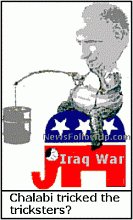

 Facebook
 YouTube
 chiffonrouge.org
<
chiffonrouge.org
<
