| NewsFollowUp.com | sitemap | home |


Robert Booth Nichols? video
|
||||||||
| Bush
& PNAC
|
Bush, Looting Fed Banks
Robert Booth Nichols? video |
|||||||
| related topics | ||
|
| July 15 (Bloomberg) -- As Samuel Israel grew desperate to raise
money in 2004 to save his Bayou Group LLC hedge fund firm, he turned for
help to a Hawaii man who promised a windfall and then conned him out of
$10 million, said a U.K. investigator. ... Robert Booth
Nichols cheated Israel, later convicted in his own $400 million theft,
in a ``prime bank'' fraud, a scheme used by con-artists promising quick
riches in secret markets, the U.K. investigator said in a document filed
in June in federal court in New York. U.S. prosecutors seeking to
recover funds for Bayou investors won a British judge's ruling in
November freezing $1 million Nichols held there, and they may be
pursuing millions more in Singapore, Nichols's lawyer said.
... ``Israel was defrauded,'' wrote Stephen Annis, an
investigator in the U.K.'s Assets Recovery Agency. Nichols, who Annis
said was under investigation by U.S. prosecutors as of November,
``benefited from his criminal conduct.'' ...
Israel hid losses from Bayou investors before his fund collapsed in
2005. He pleaded guilty and is now in prison after faking suicide and
jumping bail to avoid a 20-year sentence. Prosecutors and Bayou's
bankruptcy estate have sued to recover funds for investors who lost $250
million. ... Bayou's lawyers asked a
bankruptcy judge yesterday to order 33 investors to return $89 million.
They said the payouts were fraudulent transfers under bankruptcy law and
that the hedge funds and individuals who received the money should have
seen the ``red flags'' of fraud. The estate has already recovered $30
million.
Bayou Lawsuit Separately, Bayou is suing Nichols, who once claimed to have worked for the CIA, and his wife, Ellen, and U.S. prosecutors are pursuing their assets. Annis's statement, written Nov. 13, 2007, as part of a U.S. bid to freeze Nichols's U.K. account, was filed last month in Bayou's New York lawsuit against Nichols. .. ``This is the investors' money,'' Ross Intelisano, a lawyer who represents 20 Bayou investors, said of the funds given to Nichols. Gary Mennitt, a lawyer for the bankruptcy estate of Stamford, Connecticut-based Bayou, declined to comment. ... Nichols, 65, denies wrongdoing and seeks to retain the $1 million. He said in court papers that he helped Israel invest in a legitimate, though unspecified ``project'' involving U.S. government obligations. Nichols said he had no reason to believe Israel was engaged in fraud. ... ``He was asked to find something, and he found it,'' Nichols's lawyer, Joseph Bainton, said in an interview, declining to elaborate. ``There are very few people capable of performing this service, for which he was paid a lump sum of $10 million.'' `Suicide Is Painless' Israel, whose sentence in April included a $300 million fine, faces 10 additional years in prison for jumping bail. On June 9, the day he was to report to prison, his car was found on a bridge north of New York City with the words ``suicide is painless'' written in the windshield dust. On July 2, he surrendered to police in Massachusetts. In 1998, Bayou's finance chief, Daniel Marino, and co- founder James Marquez created a sham accounting firm to serve as the fund's auditor rather than report modest setbacks. Israel admitted he led a years-long fraud as losses grew. ... By 2004, with their fraud unraveling, Israel and Marino were ``desperate'' for cash and began searching for high-payout, short-term investments, according to the U.S. Securities and Exchange Commission, which sued the pair in 2005. `Investment Scams' ``Israel sought to invest in a series of `prime bank instrument trading programs' in Europe,'' the SEC said in its lawsuit. ``These program, which themselves are an enduring staple among fraudulent investment scams, required that large sums of money be sent to various foreign and domestic banks.'' ... In most such scams, con artists claim to have access to a secret trading market among top banks, or prime banks, where they buy notes, guarantees or debentures at a discount, yielding high returns for investors with no risk. ``In reality, no such instruments or market exists,'' Annis, the U.K. investigator, said. According to Annis, Israel turned to Nichols, who in a 1993 lawsuit claimed to have worked for the U.S. Central Intelligence Agency for 20 years. Nichols was also the target of a 1987 probe by the Federal Bureau of Investigation of organized crime in the entertainment industry, the Hollywood Reporter said in 1993. Bainton said he's unaware of charges being filed against Nichols. ... Nichols claimed to have experience with prime bank investments, Annis said. Israel traveled in April 2004 to London, where two people referred by Nichols told him the investment was safe, Annis said. Money Transfers On Nichols's instruction, Israel moved $120 million through accounts in Europe and North America, and ultimately $100 million in Bayou funds made its way into a Wachovia Bank account in New Jersey, the SEC said. In May 2005, the Arizona Attorney General seized the money after concluding it was related to fraud. The $100 million will go to Bayou investors. ... Also in 2004, Nichols told Israel he needed a short-term loan he'd repay with his share of their ``extraordinary profits,'' Annis wrote. Israel advanced Nichols $10 million, of which $1.06 million ended up in the U.K. account -- money now frozen by the U.S. That year, Nichols fabricated a document that made it appear as if the $10 million was a fee for services, Annis said. ... Nichols ``has shown he is capable of setting up and operating a large-scale fraudulent enterprise,'' Annis wrote. President's Cousin Nichols said in court papers that he believed the investment was on behalf of Israel personally, that Nichols was told his services ``involved matters of national interest,'' and that a first cousin of President Bush, John P. Ellis, vouched for the legitimacy of the transaction. Nichol said the deal required him to contact representatives of foreign governments that he knew, according to court documents. Bainton wouldn't elaborate on the investment's ``national interest.'' ``Mr. Ellis attended some meetings and gave Mr. Nichols some assurance with respect to the approval of the United States,'' Bainton said. Ellis worked at GH Venture Partners in 2004, Nichols said. ``These allegations are ridiculous, and I categorically deny them,'' Ellis said in a phone interview. Traveling Nichols has homes in Hawaii and California, according to court papers and public records. A woman answering the phone at Nichols' California home, who said her name was Eleanor, said Nichols and his wife were traveling. ... Rebekah Carmichael, a spokeswoman for U.S. Attorney Michael Garcia in New York, declined to comment, as did Israel's lawyer, Barry Bohrer. ... U.S. District Judge Colleen McMahon on July 3 said she was doubtful the money paid to Nichols came just from Israel. She said she ``has not yet been apprised of any money'' in Israel's pocket ``that did not actually belong to Bayou.'' ... Israel, who cooperated with prosecutors after he pleaded guilty in 2005, claims he was duped. In a legal brief filed on his behalf before sentencing, Bohrer wrote, ``Sam Israel is the victim of fraud.'' Other details in the brief are redacted. The criminal case is U.S. v. Israel, 05cr1039, U.S. District Court, Southern District of New York (Manhattan). The bankruptcy case is In re Bayou Group LLC, 06-22306, U.S. Bankruptcy Court, Southern District New York (White Plains). To contact the reporters on this story: David Glovin in Manhattan federal court at dglovin@bloomberg.net; Bob Van Voris in New York at rvanvoris@bloomberg.net; To contact the editors responsible for this story: Patrick Oster at poster@bloomberg.net; Larry Edelman at ledelman3@bloomberg.net. |
| Bush top | ||
| PROGRESSIVE | CONSERVATIVE* | |
|
|
|
|
||||
| Rice Watch top | ||||
| PROGRESSIVE | REFERENCE | CONSERVATIVE* | ||
|
|
|
||
|
||||||||||
| Rice, Chevron top | ||||||||||
| PROGRESSIVE | REFERENCE | CONSERVATIVE* | ||||||||
|
|
|
||||||||
| Downing Street Memo and text top | ||
| PROGRESSIVE | CONSERVATIVE* | |
|
|
|
| Downing Street Memo, Reference top | ||
| REFERENCE | REFERENCE | REFERENCE |
|
|
|
|
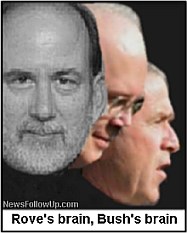 Michael
Ledeen- 'Rove's brain', and Rove - 'Bush's brain'. Michael
Ledeen- 'Rove's brain', and Rove - 'Bush's brain'.
|
|
|
from Aztlan.net Condoleezza Rice was a Chevron Director from 1991 until January 15, 2001 when she was transferred by President George Bush Jr. to National Security Adviser. Previously she was Senior Director, Soviet Affairs, National Security Council, and Special Assistant to President George Bush Sr. from 1989 to 1991. Another Chevron Corporation giant in the Bush administration is Vice President Dick Cheney. Vice President Cheney was Chairman and Chief Executive of Dallas based Halliburton Corporation, the world’s largest oil field services company with multi-billion dollar contracts with oil corporations including Chevron. Lawrence Eagleburger, a seasoned Bush counselor who held top State Department posts under George Bush Sr., is a director of Halliburton Corporation. Halliburton's global network of investments includes projects in politically volatile areas including the Caspian Sea region. Dick Cheney was instrumental in negotiating a Caspian Sea pipeline for Chevron. The crude oil pipeline is a 900-mile project stretching from western Kazakhstan to the Black Sea that will primarily benefit Chevron by connecting the Tengiz oil field to the Black Sea port of Novorossiysk in Russia. Chevron, the largest oil company member of the Caspian Pipeline Consortium, holds a 55 percent ownership interest with the Republic of Kazakhstan in Tengizchevroil. The 40-year, $20 billion joint-venture company was formed in 1993 to develop the Tengiz field. Tengiz is one of the world’s largest oil fields with 6 to 9 billion barrels of recoverable oil. Also, there are allegations that the Bush Administration declared war in Afghanistan, not necessarily to combat terrorism, but to make it possible for U.S. oil interests to construct gas and oil pipelines from the Caspian Sea through Afghanistan to Pakistani harbors on the Indian Ocean. The first phase, now accomplish, was to install a friendly "puppet" regime in Kabul. La Voz de Aztlan has a report on this subject at:
|
||
|
The Sunday Times - Britain May 01, 2005 The secret Downing Street memo , fair useSECRET AND STRICTLY PERSONAL - UK EYES ONLY DAVID MANNING, From: Matthew Rycroft, Date: 23 July 2002, S 195 /02 23 July 2002, S 195 /02 23 July 2002, S 195 /02cc: Defence Secretary, Foreign Secretary, Attorney-General, Sir Richard Wilson, John Scarlett, Francis Richards, CDS, C, Jonathan Powell, Sally Morgan, Alastair Campbell IRAQ: PRIME MINISTER'S MEETING, 23 JULY Copy addressees and you met the Prime Minister on 23 July to discuss Iraq. This record is extremely sensitive. No further copies should be made. It should be shown only to those with a genuine need to know its contents. John Scarlett summarised the intelligence and latest JIC assessment. Saddam's regime was tough and based on extreme fear. The only way to overthrow it was likely to be by massive military action. Saddam was worried and expected an attack, probably by air and land, but he was not convinced that it would be immediate or overwhelming. His regime expected their neighbours to line up with the US. Saddam knew that regular army morale was poor. Real support for Saddam among the public was probably narrowly based. C reported on his recent talks in Washington. There was a perceptible shift in attitude. Military action was now seen as inevitable. Bush wanted to remove Saddam, through military action, justified by the conjunction of terrorism and WMD. But the intelligence and facts were being fixed around the policy. The NSC had no patience with the UN route, and no enthusiasm for publishing material on the Iraqi regime's record. There was little discussion in Washington of the aftermath after military action. CDS said that military planners would brief CENTCOM on 1-2 August, Rumsfeld on 3 August and Bush on 4 August. The two broad US options were: (a) Generated Start. A slow build-up of 250,000 US troops, a short (72 hour) air campaign, then a move up to Baghdad from the south. Lead time of 90 days (30 days preparation plus 60 days deployment to Kuwait). (b) Running Start. Use forces already in theatre (3 x 6,000), continuous air campaign, initiated by an Iraqi casus belli. Total lead time of 60 days with the air campaign beginning even earlier. A hazardous option. The US saw the UK (and Kuwait) as essential, with basing in Diego Garcia and Cyprus critical for either option. Turkey and other Gulf states were also important, but less vital. The three main options for UK involvement were: (i) Basing in Diego Garcia and Cyprus, plus three SF squadrons. page 2 (ii) As above, with maritime and air assets in addition. (iii) As above, plus a land contribution of up to 40,000, perhaps with a discrete role in Northern Iraq entering from Turkey, tying down two Iraqi divisions. The Defence Secretary said that the US had already begun "spikes of activity" to put pressure on the regime. No decisions had been taken, but he thought the most likely timing in US minds for military action to begin was January, with the timeline beginning 30 days before the US Congressional elections. The Foreign Secretary said he would discuss this with Colin Powell this week. It seemed clear that Bush had made up his mind to take military action, even if the timing was not yet decided. But the case was thin. Saddam was not threatening his neighbours, and his WMD capability was less than that of Libya, North Korea or Iran. We should work up a plan for an ultimatum to Saddam to allow back in the UN weapons inspectors. This would also help with the legal justification for the use of force. The Attorney-General said that the desire for regime change was not a legal base for military action. There were three possible legal bases: self-defence, humanitarian intervention, or UNSC authorisation. The first and second could not be the base in this case. Relying on UNSCR 1205 of three years ago would be difficult. The situation might of course change. The Prime Minister said that it would make a big difference politically and legally if Saddam refused to allow in the UN inspectors. Regime change and WMD were linked in the sense that it was the regime that was producing the WMD. There were different strategies for dealing with Libya and Iran. If the political context were right, people would support regime change. The two key issues were whether the military plan worked and whether we had the political strategy to give the military plan the space to work. On the first, CDS said that we did not know yet if the US battle plan was workable. The military were continuing to ask lots of questions. For instance, what were the consequences, if Saddam used WMD on day one, or if Baghdad did not collapse and urban war fighting began? You said that Saddam could also use his WMD on Kuwait. Or on Israel, added the Defence Secretary. The Foreign Secretary thought the US would not go ahead with a military plan unless convinced that it was a winning strategy. On this, US and UK interests converged. But on the political strategy, there could be US/UK differences. Despite US resistance, we should explore discreetly the ultimatum. Saddam would continue to play hard-ball with the UN. John Scarlett assessed that Saddam would allow the inspectors back in only when he thought the threat of military action was real. The Defence Secretary said that if the Prime Minister wanted UK military involvement, he would need to decide this early. He cautioned that many in the US did not think it worth going down the ultimatum route. It would be important for the Prime Minister to set out the political context to Bush. Conclusions: (a) We should work on the assumption that the UK would take part in any military action. But we needed a fuller picture of US planning before we could take any firm decisions. CDS should tell the US military that we were considering a range of options. (b) The Prime Minister would revert on the question of whether funds could be spent in preparation for this operation. page 3 (c) CDS would send the Prime Minister full details of the proposed military campaign and possible UK contributions by the end of the week. (d) The Foreign Secretary would send the Prime Minister the background on the UN inspectors, and discreetly work up the ultimatum to Saddam. He would also send the Prime Minister advice on the positions of countries in the region especially Turkey, and of the key EU member states. (e) John Scarlett would send the Prime Minister a full intelligence update. (f) We must not ignore the legal issues: the Attorney-General would consider legal advice with FCO/MOD legal advisers. (I have written separately to commission this follow-up work.) MATTHEW RYCROFT (Rycroft was a Downing Street foreign policy aide)
|
| Lawyer: Rice Allegedly Leaked Defense Info Washington Post fair use |
|
By MATTHEW BARAKAT The Associated Press Saturday, April 22, 2006; 12:59 AM ALEXANDRIA, Va. -- Secretary of State Condoleezza Rice leaked national defense information to a pro-Israel lobbyist in the same manner that landed a lower-level Pentagon official a 12-year prison sentence, the lobbyist's lawyer said Friday. Prosecutors disputed the claim. The allegations against Rice came as a federal judge granted a defense request to issue subpoenas sought by the defense for Rice and three other government officials in the trial of Steven Rosen and Keith Weissman. The two are former lobbyists with the American Israel Public Affairs Committee who are charged with receiving and disclosing national defense information. Defense lawyers are asking a judge to dismiss the charges because, among other things, they believe it seeks to criminalize the type of backchannel exchanges between government officials, lobbyists and the press that are part and parcel of how Washington works. During Friday's hearing, U.S. District Judge T.S. Ellis III said he is considering dismissing the government's entire case because the law used to prosecute Rosen and Weissman may be unconstitutionally vague and broad and infringe on freedom of speech. Rosen's lawyer, Abbe Lowell, said the testimony of Rice and others is needed to show that some of the top officials in U.S. government approved of disclosing sensitive information to the defendants and that the leaks may have been authorized. Prosecutors opposed the effort to depose Rice and the other officials. Assistant U.S. Attorney Kevin DiGregory also disputed Lowell's claim, saying, "She never gave national defense information to Mr. Rosen." The issuance of subpoenas does not automatically require Rice or anybody else to testify or give a deposition. A recipient can seek to quash the subpoena. Calls to the State Department seeking comment Friday evening were not immediately returned. The judge also granted subpoenas for David Satterfield, deputy chief of the U.S. mission to Iraq; William Burns, U.S. ambassador to Russia and retired Marine Gen. Anthony Zinni. "Each of these individuals have real-life dealings with the defendants in this case. They'll explain what they told Dr. Rosen in detail," Lowell said. "On day one, Secretary of State Rice tells him certain info and on day two one of the conspirators tells him the same thing or something less volatile." The indictment against Rosen and Weissman alleges that three government officials leaked sensitive and sometimes classified national defense information to the two, who subsequently revealed what they learned to the press and to an Israeli government official. One of the three government officials is former Pentagon official Lawrence A. Franklin, who pleaded guilty to providing classified defense information to Rosen and Weissman and was sentenced to more than 12 years in prison. Franklin has said he was concerned that the United States was insufficiently concerned about the threat posed by Iran and hoped that leaking information might eventually provoke the National Security Council to take a different course of action. The indictment against Rosen, of Silver Spring, Md., and Weissman, of Bethesda, Md., alleges that they conspired to obtain classified government reports on issues relevant to U.S. policy, including the al-Qaida terror network; the bombing of the Khobar Towers dormitory in Saudi Arabia, which killed 19 U.S. Air Force personnel; and U.S. policy in Iran. Lowell said it is impossible for Rosen and Weissman to determine what is sensitive national defense information when they are receiving the information from government officials who presumably understand national security law and therefore would not improperly disclose national defense information. The World War I-era law has never been used to prosecute lobbyists before.
|
| Senate Bill 3774 |
Nieman
Foundation for Journalism at Harvard University "Kit
Bond's anti-whistle blower, anti-accountability bill ...
Senate Bill 3774 is the latest piece of legislation allegedly aimed at
protecting national security. Introduced by Senator Kit Bond (R-MO), it
would criminalize unauthorized disclosure of classified information. This
bill is dangerously vague and provides virtually unlimited discretion to
the Department of Justice in deciding whom to prosecute. It would be a
catastrophe for reporters and the free press. Search AIPAC, Rosen,
Weissman  |




 Chevron tanker, Condoleeza
Rice
Chevron tanker, Condoleeza
Rice