| sitemap | home |
Carlyle Group

Anthrax Timeline continued below
 below
below
and Carlyle Group connections
|
||||||||
|
||||||||
|
||||||||||||||
|
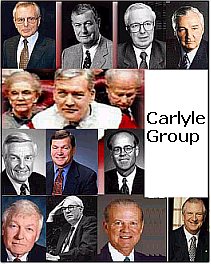
Carlyle Group
|
BioPort, Emergent BioSolutions
Anthrax Timeline continued below
and Carlyle Group connections |
|
|
|||||||||||
|
||||||||||||||
| Carlyle Group | ||
| PROGRESSIVE | REFERENCE | CONSERVATIVE* |
|
|
|
|
||
| Ivins, Judith Miller, BioPort Timeline continued go to Timeline begin | |
|
|
| Bruce Ivins top | |||
| PROGRESSIVE | REFERENCE | CONSERVATIVE | |
|
|
|
|
| David Kelly / Judith Miller top | |||
| PROGRESSIVE | REFERENCE | CONSERVATIVE | |
|
|
|
|
| Carlyle Capital Nears Collapse as Rescue Talks Fail
(Update7) By Edward Evans
March 13 (Bloomberg) -- Carlyle Group said creditors plan to seize the assets of its mortgage-bond fund after it failed to meet more than $400 million of margin calls on mortgage- backed collateral that plunged in value. Carlyle Capital Corp., which began to buckle a week ago from the strain of shrinking home-loan assets, said in a statement it defaulted on about $16.6 billion of debt as of yesterday. The dollar fell to a 12-year low against the yen and European stocks tumbled. The fund fell 87 percent in Amsterdam trading. Carlyle Group, co-founded by David Rubenstein, tapped public markets for $300 million in July to fuel the fund just as rising foreclosures caused credit markets to seize up. In the past month, managers led by Peloton Partners LLP have closed at least a dozen funds, sold assets or sought fresh capital as banks tightened lending standards. ``If Carlyle's lenders want their money right away, they'll liquidate the fund,'' said Hank Calenti, a London-based analyst at RBC Capital Markets. ``That will put pressure on already stressed credit markets.'' Lenders will ``promptly'' take over all of its remaining assets after it failed to reach an agreement with lenders, Carlyle Capital said. Any remaining debt is expected to go into default ``soon,'' the fund added. `Single Fund' The fund's losses were caused by ``excessive leverage,'' said Arthur Levitt, a senior Carlyle adviser, in a Bloomberg Radio interview today. ``This did not affect the overall Carlyle enterprise,'' said Levitt, former chairman of the Securities and Exchange Commission and a board member of Bloomberg LP, the parent of Bloomberg News. ``This was a single fund, and I suspect as this plays out, you are going to see a lot of other private-equity companies, a lot of banks, going down the same road,'' he said. Carlyle Capital's plea for refinancing on residential mortgage-backed securities failed late yesterday after a pricing service used by some lenders reported a decrease in the value of the assets, the firm said. ``The basis on which lenders are willing to provide financing against the company's collateral has changed so substantially that a successful refinancing is not possible,'' Carlyle said in the statement. It expects additional margin calls today of $97.5 million. `All Options' Carlyle Group and its funds are not liable for repurchase agreements that Carlyle Capital used to buy residential mortgage-backed securities, Hong Kong-based spokeswoman Dorothy Lee said in an e-mail today. ``The Carlyle Group's only material financial exposure to CCC is through a $150 million unsecured subordinated revolving credit agreement with CCC,'' she said. ``At this point we are exploring all options'' for Carlyle Capital, Emma Thorpe, a spokeswoman for Carlyle Group in London, said in a telephone interview. She declined to specify the options being considered. Carlyle Group said in a statement it had worked ``exhaustively'' with the fund to negotiate new financing. ``Carlyle took extraordinary measures to help CCC manage through its liquidity crisis,'' the e-mailed statement said. ``Unfortunately, extreme volatility and market movement during this liquidity crisis created a hostile environment for CCC and similar types of vehicles.'' Carlyle's fund has said its so-called agency debt has an ``implied guarantee'' from the U.S. government. Contagion Delay The industry is reeling from its worst crisis because bankers -- staggered by almost $190 billion of asset writedowns and credit losses -- are raising borrowing rates and demanding extra collateral for loans. The Standard & Poor's 500 Index fell as much as 2 percent today, gold traded at $1,000 an ounce for the first time in New York and Treasuries extended gains as investors took the collapse of the talks as a sign that credit losses are deepening. ``This is not only a problem for Carlyle,'' Jochen Felsenheimer, the Munich-based head of credit strategy at UniCredit SpA, wrote in a note to clients today. ``We expect a further flood of downgrades especially of higher-rated securities, putting enormous pressure on the system.'' Carlyle Capital originally delayed and then cut the size of its IPO by about 25 percent as the subprime contagion began. In all, the fund used about $670 million of equity to amass a $22 billion portfolio of mortgage debt. For every dollar of equity, the pool borrowed $32. ``It was a poorly conceived fund launched at the worst time,'' said Toby Nangle, a member of the strategic policy group at Baring Asset Management in London, which manages $55 billion. The shares, first sold to investors for $19 each, fell $2.45 to 35 cents today. `Monitoring Developments' ``At this moment there's no cause for us to suspend trading'' in Carlyle Capital, Paul van Dijk, a spokesman for the Dutch securities regulator AFM in Amsterdam, said in an interview today. ``We're closely monitoring developments.'' Carlyle's counterparties are a dozen Wall Street firms including Citigroup Inc. and Deutsche Bank AG, according to the fund's annual report. The banks use repurchase agreements to lend money and require securities be put up as collateral. As the perceived creditworthiness of asset-backed bonds declined, the amount of money that can be borrowed using them as collateral fell. Not the End Drake Management LLC, the New York based-firm started by former BlackRock Inc. money managers, said yesterday it may shut its largest hedge fund, while GO Capital Asset Management BV blocked clients from withdrawing cash from one of its funds. Other funds hit include Peloton Partners LLP's $1.8 billion ABS Fund, Tequesta Capital Advisor's mortgage fund and Focus Capital Investors LLC, which invested in midsize Swiss companies. ``Carlyle won't be the end of it,'' said Greg Bundy, executive chairman of Sydney-based merger advisory firm InterFinancial Ltd. and a former head of Merrill Lynch & Co.'s Australian unit. ``There's more to come. The problem is no one can give you an educated guess about how much.'' To contact the reporter on this story: Edward Evans in London at at eevans3@bloomberg.net
|
| continued Miller article |
|
BioPort had been reluctant to discuss its protracted, often tense negotiations with the government, which officials attribute partly to the Michigan plant's well-documented production problems. The plant was renovated from 1999 to 2001 to meet the drug agency's standards. The military invested some $75 million in the renovations, but even after them, agency inspectors found many deficiencies that kept the plant from making new vaccine and releasing some 500,000 existing doses until late January. Some problems have lingered, such as the company's decision in June to discard 180,000 doses of vaccine that it called substandard. Mr. Kramer characterized the incident as a "nonevent" and "a normal part of the manufacturing process." The decision, he said, "had no impact on the production schedule and our ability to meet our obligation to the government." But Anna Johnson-Winegar, a civilian microbiologist for the Army who oversees some of the military's vaccine programs, said that the incident showed how tricky it was to estimate BioPort'sproduction capacity and to figure how much surplus the company might have for non-government customers. The company's production estimates, Dr. Johnson-Winegar said, "assumes that everything will go well." "It assume a perfect world," she said. Nevertheless, Dr. Johnson-Winegar expressed some sympathy for the company in its growing frustration with the pace of the government's negotiations. "They do need money for re-capitalization," she said. "But that's difficult since they are for the moment a one-product company with one customer." At the same time, other Pentagon officials complained, BioPort's financial predicament is partly the result of its own miscalculations. "They initially underestimated how much it would cost to produce product that could meet F.D.A. standards, or how much of their costs the State of Michigan, which once owned the plant, routinely picked up," one official said. The assumption that the company could turn a profit as the sole supplier of anthrax vaccine "may have been overly optimistic," the official said. BioPort was bought in 1998 for nearly $25 million by a group of private investors, including executives who had worked at the plant under Michigan ownership; Fuad El-Hibri; and Adm. William J. Crowe Jr., a former chairman of the Joint Chiefs of Staff. Many details of BioPort's contract and its production obligations are secret. But Pentagon officials said the company was permitted to sell up to 20 percent of its annual production after it produced the estimated 3.4 million doses that the Pentagon agreed to buy in 1999. While neither the government nor the company will say how much vaccine BioPort is producing, or its production capacity, Mr. Kramer said the government was "taking delivery of doses as fast as we can produce them."
|
June 18, 2006 -- WMR (Wayne Madsen) has heard through the grapevine that Karl Rove and his pimply-faced minions at the Republican National Committee and right-wing boiler shops around the country are going to target this editor WMR
Wayne Madsen New “Person of Interest” in
Anthrax Probe ? An OSI News
Exclusive ! OSI : Information THEY don’t want you to see
… Washington, June 4, 2006 : Federal investigators have
refused to comment on rumors a mysterious “ W. MADSEN” ,who
is said to have had ties to and dealings with the controversial
NSA “spy shop”,is being “looked at as a person of
interest” in the nearly five-year-old Amerithrax
investigation.
http://www.fbi.gov/anthrax/amerithraxlinks.htm We have been able to confirm there is a Wayne Madsen : self-described as a Washington-based investigative reporter, who was employed by NSA during the Reagan Administration , and who is, to judge by his website : https://www.waynemadsenreport.com/ still privy to much top-secret government information. Our informants point out that Washington, DC is not very far from Ft. Detrick, Maryland-home of the Army’s Bio-research program-and a relatively short train ride away from Princeton, NJ , location of the deadly “anthrax mailbox” .
|
 WMR
August 22, 2005 -- Four Americans flew with "Air Bin Laden" flight
transporting Bin Laden family members to Saudi Arabia and Europe nine
days after 911.
WMR
August 22, 2005 -- Four Americans flew with "Air Bin Laden" flight
transporting Bin Laden family members to Saudi Arabia and Europe nine
days after 911. |
| The post-911 domestic flights of Bin Laden family members out of the United States with the sanction of the Bush White House were not the only instances where Americans have flown with the family that spawned "Al Qaeda" leader Osama Bin Laden. WMR has obtained a passenger list from a September 20, 2001 Aero Services private charter flight from Le Bourget Airport, north of Paris, to Geneva, and on to Jeddah, Saudi Arabia (King Abdulaziz International Airport-OEJN). On the list are a number of Bin Ladens, as well as four Americans, including a Los Angeles Police Department officer named Jason Blum who flew to Le Bourget from Los Angeles. A previous list provided to Sen. Frank Lautenberg showed Mr. Blum departing from the Bin Laden party in Boston.The newly obtained list shows he accompanied the Bin Ladens to Paris Le Bourget. The other three Americans on the passenger list are J.P. Buonono, Joseph Allen Wyka and Ricardo V. Pascetta. Because of these discrepancies, it is uncertain whether the destination information as stated on the manifest provided to Sen. Lautenberg (and presumably the 911 Commission) was, in fact, accurate. However, French intelligence is in possession of documents showing that some of the Americans accompanied the Bin Ladens to Jeddah. In addition, two Bin Ladens with U.S. citizenship were also on the charter flight: Khalil Sultan Binladen and Badr Ahmed Bin Laden. A British citizen, Akberali [sic] Moawalla [sic], identified by French intelligence as the same Akbar Moawala (the Tanzanian in the French intelligence report below regarding SICO and Fluor Corp.), was also on the flight. A Brazilian, Yemeni, and Indonesian were on the same flight. A Saudi diplomatic passport holder named Kholoud Osama Kurdi accompanied the passengers to Jeddah. What is significant about Mr. Kurdi is that the Bush administration claimed the Saudi flights were purely "private" in nature. Shafig Bin Laden, who had attended a Washington, DC meeting of the Carlyle Group at the Ritz Carlton Hotel on the morning of September 11 (George H. W. Bush and James Baker were present at the same meeting the day before), left the charter flight in Geneva, one of the centers for George H. W. Bush's international slush funds. The parties arriving at Le Bourget for the onward flight to Geneva and Jeddah flew from Los Angeles International, Dulles International, Boston Logan, and Orlando International. |
| Excerpt from, "Our Generals Don’t Even Know Who We Are" Copyright 2006 by David DeBatto www.davedebatto.com Coming From by Cumberland House Publishing in October |
| Amar Abdul Rahman was a survivor. He was also a
fiercely patriotic Iraqi and thought of himself as an honest man – two
things that did not always go together. Rahman had served for over
fifteen years in the Iraqi Air Force as a Chief Warrant Officer in
charge of all munitions in Region 6 – a vast, mostly desert area in
north-central Iraq straddling the Tigris River approximately 80
kilometers north of Baghdad. There were several military installations
located within Region 6, the largest being his current duty station, al-Bakr
Air Force Base, named after Iraq’s fourth president - Hassan Ahmed al-Bakr.
Al-Bakr was a very popular president and he was especially beloved by
the female population of Iraq. He even had his own contingent of
“groupies” present whenever he would appear in public. Many public
statues of Al-Bakr were built all over Iraq as a tribute to his
popularity. The common people just adored him.
He was of course assassinated. It was nothing personal. That was just the Iraqi way. As a Shiite Muslim, Rahman knew that he would never have a chance at becoming a high ranking military officer. Those positions were all reserved for the suck-up Sunni loyalists who composed nearly all of the senior officer positions in the Saddam military. Yes, a few token Shia and even the odd Kurd here and there had been given some meaningless staff officer jobs from time to time, just to appease the masses, but everyone knew that all of the important roles in the Iraqi military and civilian leadership were reserved for members of Saddam’s own religious sect - the minority Sunni population. The most inner circles of Saddam loyalists were restricted further still to include only members of his own Tikriti tribe, all of whom were directly related to Saddam. At the innermost circle of all were immediate family members that made up what was referred to as the “Circle of 40.” They alone had direct and daily access to the Iraqi dictator. Their access to Saddam was trumped only by that of his two sons – Uday and Qusay. Tribal affiliation and blood ties are absolutely everything in Iraq. They always have been and were made even more important under Saddam. Rahman accepted that fact, just as he had accepted everything else about life in Iraq since the reign of Saddam began in the late 1970’s. In fact, at age 34, he had really never known any other way of life. It could be harsh and unforgiving to be sure, but if one did as they were told, stayed away from politics and did well in school as well as with their compulsory service in the military, one could manage to have an acceptable, if not well to do life. That was the most Rahman had ever expected and for the most part, he was happy with his lot in life. As fate would have it however, Rahman is a distant relative of the number two man in the Iraqi government – Izzat Ibrahim al-Duri. Al-Duri is Saddam’s right hand man and second in charge to Saddam of the ruling Ba’ath Party, Deputy Commander of the Iraqi Military and the Vice Chairman of the Revolutionary Command Council. This fact had enabled Rahman to bypass the compulsory one-year service in the Iraqi Army as a lowly infantry soldier in 1988 and to enlist in the more respected and better paid Iraqi Air Force as a Warrant Officer, a position usually reserved for career service members as a reward for their loyalty and for bribes paid to senior officers over the years. Rahman considered himself extremely fortunate to have such a relative, even if it was a distant relative by marriage only – a distant in-law to be more accurate. But family was family and in Iraq, that was usually enough. After receiving his initial military training in 1988 at Taji Air Force Base just north of Baghdad, Rahman was next stationed at the large air base in the As-Sulaymaniyah province located in northeastern Iraq and very close to the Iranian border. During the 10-year Iran-Iraq war that had just ended a few months’ earlier, As-Sulaymaniyah was one of the most active military posts in the country and had been on the receiving end of several Iranian Air Force bombing sorties into Iraq. There was still considerable damage to the base when he arrived in early fall 1989 and some basic services like sewage and electricity were not fully restored. Rahman was placed under the supervision of a senior Warrant Officer who would mentor him in his new occupation. Rahman was a very good student and he soaked up all of his training just like the parched Iraqi desert after a thunderstorm. He was proud to serve in such a trusted position. During his six year tour at As-Sulaymaniyah, he received advanced training in the identification, transportation and storage of munitions and ordinance – in lay terms, weapons - all kinds of weapons ranging from landmines and machineguns to high explosive bombs and - WMD, specifically, chemical WMD. Of course, Iraqi had no WMD, right? Well, whatever WMD that Iraq didn’t have in Region 6 was about to be placed under the direct supervision of Munitions and newly promoted Chief Warrant Officer Amar Abdul Rahman - and Rahman had become a very good munitions officer. In 1995 Rahman was transferred to al-Baker Air Force Base and for the first time in his career, he alone now assumed the responsibility of all munitions in his region. He was ready. Al-Baker was located in one of the most rural areas of Iraq. In fact, when the base was built in 1982 by Yugoslav and German contractors, Saddam had to seize thousand of acres of prime farmland and fruit orchards from the local farmers in order to build his immense new base. That did not sit well with the farmers and local tribal leaders, many of whom were Shia. They protested to Baghdad over the illegal land grab. Saddam soon sent in some agents from the Mokabarat (Iraqi Secret Service) and after several farmers disappeared and/or turned up beheaded, the controversy came to an abrupt end and the base was completed as scheduled. Rahman enjoyed his new assignment and he dutifully cataloged everything in his charge and followed his orders to the letter, just as he had been taught since grade school. He had two junior officers and over 20 Air Force technicians assigned directly under him to assist with the inventorying, packing, labeling and transportation of the massive amounts of weapons systems and ammunition that he was responsible for. In addition to the 25 square km base at al-Baker, Rahman was also responsible for the 5 square km base munitions annex located approximately 3 km south of the base. It was at this sub-post that Rahman actually had his office and also where he kept his records. Shortly after arriving at al-Bakr in the summer of 1996, Rahman received an unexpected visit from the Iraqi Air Force Vice Chief of Staff, Maj. General Hamid Raja Shalah. Shalah had made a special trip from Air Force headquarters in Baghdad to speak with Rahman in person because he felt that the subject was so sensitive that he did not trust talking on the telephone and he certainly would not use the unreliable Iraqi military radio communications system. No, this was a matter to be handled in person, one to one, face to face. Gen. Shalah met with his eager new officer in Rahman’s cramped and dusty office at the annex. Rahman was understandably nervous since this was the highest ranking officer he had ever met and he did not know what to expect. The general spoke first. “Rahman, what I am about to tell you does not leave this room.” Now Rahman was really nervous, but he managed to spit out a short, “Yes Sir.” “As chief munitions officer for Region 6, you will be responsible for some sensitive items that very few people in this country even know about, including your base commander. I am talking about chemical weapons that have been banned by the United Nations. Weapons that our president has sworn we no longer have. Do you understand me so far?” Banned weapons? I will be responsible? I don’t need this! But a crisp “Yes Sir!” was what actually came out of his mouth. “You will be receiving a shipment of some of these items next week on two unmarked flatbed trucks accompanied by Mukhabarat personnel. Obey their instructions exactly Rahman and you will be well rewarded by me. Understand?” “Thank you sir” was the only thing Rahman could think of to say, at least to this guy anyway. The “items” were indeed delivered the next week as the general had promised and Rahman followed the instructions he was given by the plainclothes intelligence agents accompanying the shipment. The weapons were inventoried, cataloged in his records and stored in a reinforced bunker on the main base. No one was told of their arrival or location, not even the base commander. Damn! Rahman thought. I just hope we never to go to war with the Americans again. I don’t want to have to deal with this! He spent the next seven years playing a kind of shell game with the UNSCOM inspectors sent by the UN to monitor Iraq’s WMD program. Whenever UNSCOM sent one of its inspectors such as Scott Ritter or Hanz Blix, he would bury the WMD before they arrived, deny their existence and when they were gone, the large construction equipment, always under the watchful eye of the Mukhabarat, would dig them up and move them to another location in the region. Rahman became very good at the game and he thought he would do so until retirement. However, on April 9, 2003 all that changed. That was the day the Iraqi forces defending al-Bakr deserted their posts after several days of bombing and brutal assaults by the American Air Force as well as units of infantry and armored forces of the U.S. Army’s Third Infantry Division. The cavernous main hanger had a huge crater in the middle of the roof and floor, the two main runways were pockmarked with bomb craters and the base was littered with burnt out hulks of Iraqi military vehicles and giant MIG-29s as the Iraqis attempted to tow them out of harms way. They didn’t make it. Rahman himself had ordered his men to destroy all of their munitions records. As per an impassioned phone call from Shalah the day before, Rahman had burned all records of the chemical WMD on file in his office. He gladly complied as he wanted no part of any war trials after this was all over, whenever that would be. Maybe he will be killed or taken prisoner and it will never be over for him. But eventually, it was over. Within a week or so after the initial American troops had captured and then bypassed al-Bakr on their way north to Tikrit and Mosel, a new group of U.S. soldiers arrived in a large convoy from Kuwait. They entered the sprawling, deserted and charred base through the battered south gate and set up camp in a vacant dirt field just east of the airbase control tower. These were the troops of the 223rd Military Intelligence Battalion, California Army National Guard. Among their number were a contingent of Counterintelligence Special Agents whose primary missions, among others, were the location of Saddam Hussein and Iraqi WMD. One of those agents was named David DeBatto, in Arabic, Daoud, or as he would eventually be referred to by both Iraqis and Americans alike – Mr. David, his host in this furnace of a tent on his former base. “It was a new day for Iraq”, he thought. ***** After relating his background and experience to us, Rahman told us that there was indeed WMD in this area and that he would be willing to lead us to it. Not being overly trusting of Iraqi’s at that point and certainly not of a prior Iraqi military officer, I was very skeptical of anything he told us. I asked Rahman why he was telling us all of this and he said very matter-of-factly, “Because I love my country and I want things to change.” I looked at Weichert and asked him with my eyes what he thought. Weichert’s response was to Ask Rahman if he would lead us to the weapons right now and Rahman said, “Yes, of course.” With that, the three of us got into our Humvee and drove to a bunker located at the southeast quadrant of the base, not even one mile from where were sitting. The bunker sat in a deserted part of the base that had several similar bunkers spread throughout a large area and connected by a single serpentine road. All of the bunkers were constructed of concrete covered by tan stucco, which blended in perfectly with the surrounding desert. They were of various sizes, but all had two, large metal doors which either slid to the side or opened outward, leading into the one large storage area inside. As we pulled up to the Bunker that Rahman indicated contained the WMD, I noticed that the dry, desert field surrounding the area was littered with ordinance, primarily aerial bombs. Some were rusted beyond recognition and lay half- covered in sand. Others were neatly stacked in the original shipping crates and surrounded by a high earthen berm, which looked like a small crater. The high, steel doors of the bunker were ajar. Weichert and I each pulled one of them open and the three of us entered the dark and musty storage room. Immediately upon entering, I noticed a chemical detection kit lying open on the floor, just inside the entrance. The hair on the back of my neck went up and I looked over at Weichert, who was also staring at the kit. “Holy Shit!” we both said at almost the same time. That was not what I wanted to see at that particular time. I looked closer at the detection kit and saw that it had Russian lettering - not that unusual, since Iraq had many contacts with Russian scientists, engineers and military personnel over the years. They had also purchased a large assortment of military hardware and munitions from them – to include chemicals and related equipment. Rahman pointed to a number of long wooden crates stacked up in rows three high along the wall to the left of the entrance. There appeared to be 25-30 crates in all. Two or three had their tops removed and grey, aerial bombs, about six feet in length, sat inside. Weichert and I walked over to the crates and looked at one of the open ones. It appeared to be a conventional high explosive bomb used on any number of military aircraft, both in Iraq and in elsewhere. Rahman motioned for us to come over to where he was standing next to another of the open crates. He pointed to the midsection of the bomb and to what appeared to be a small, thin metal door or covering bolted shut with small metal pins and possibly covering a slot or chamber. Inside, Rahman, explained, was a small parachute. He told us that after the bomb was dropped from the aircraft, the metal covering was blown open and the parachute deployed at about two hundred feet, slowing the descent of the bomb. A chemical agent, which was located in another chamber located at the rear of the bomb, was then dispersed into the air in an aerosol spray and spread over as large an area as the prevailing winds allowed. Rahman led us around to the rear of the bomb and pointed to the tail assembly. It had a circular piece of metal connected to spokes in a conventional sort of design, but the similarity stopped there. Where ordinarily the rear end of a conventional high explosive bomb would taper into a point, this bomb had apparently had the tail section cut off about six inches from the tip resulting in a flat, circular end. Into that flat end, a small handle was inserted like one on a drawer. Rahman motioned with his hand near the handle and said that this device was twisted in order to open the compartment and then the technician pulled the drawer out and inserted a chemical agent in the slot. When finished, the drawer was reinserted into the bomb and the handle was once again secured. The chemical WMD was now ready to be loaded onto the aircraft. Rahman next pointed to the hand lettered numbers on the side of the crates. They were numbered from 1-29. Rahman said that he placed hand-lettered numbers on each one personally and can assure us that were 29 chemical WMD bombs under his supervision. Not 28 or 30 – but 29. He seemed to be very proud of his accuracy and neatness in numbering each crate. He went on to say how he had spent the last eight years or so playing “cat and mouse” with UNSCOM (the UN inspectors). Every time they were due to come to his region for an inspection, he would be notified by his superiors. Then he would arrange for the bombs to be transported to a different area that was not going to be inspected. Sometimes, he told us, he would simply dig a deep hole near the storage facility and bury the bombs, crates and all, until the inspectors left and then dig them up again and put them back where they were. He was familiar with Scott Ritter and Hans Blix in particular and said they never found any WMD in his region. He even ran his hand along one of the crates and brushed off some dried clay, which was clinging to the outside. These were dug up after the last inspection before the war and placed back into the bunker with the large areas of clay still covering some of the crates. He was right – every one of the wooden boxes had varying amounts of dry, reddish clay – which is the common soil found at that location – caked to their wooden exteriors. These bombs had definitely been buried locally at some point just before being placed into that bunker – that was a fact. Looking around the rest of the bunker interior, I could see dozens of metal chemicals containers – some apparently unopened, and some with their tops open and with dried, powdery substances on the floor all around them and inside the containers. Some containers were covered with what appeared to be dried liquids, almost like dry paint, streaming down the sides. I can honestly say that I was having a hard time comprehending what I was seeing. Unless my senses were deceiving me, Weichert and I had actually found the mother lode of Operation Iraqi Freedom – actual Iraqi WMD. I walked over to one of the crates and saw a plastic sheath containing what appeared to be a bill of laden. I cut it open with my Leatherman and pulled the documents out. At this point I want to say that loud and clear that I very much regret not having either shoved that document in my pocket or made a copy of it and sent it home for safe keeping. At the time I actually thought that a report would be written and normal Army and intelligence protocol would be followed, so there would be no need for me to have to prove anything. But I digress… I opened the folded off-white paper form and noticed several interesting things right away. The bombs had been purchased in the United States in 1988 from what appeared to be a government contractor called The Carlyle Group. I am almost embarrassed now to say that I had not heard of The Carlyle Group at that time so the name meant nothing to me. The only reason I remember it at all is that I was amazed that the bill was in English and I was stunned to see that a bomb that was used by Iraq in delivering chemical WMD – the only WMD found during the entire Iraq war – was in fact supplied to Saddam Hussein by the United States. Un-blanking believable. The date on the bill was either 1987 or 1988, I don’t recall exactly. I do recall that the bomb was manufactured in Spain and shipped through France. So much for their claims of being holier-than-thou. I checked several more bills and they were all identical. These bombs had all been shipped together. Rahman told us that similar weapons had been used all throughout the Iran-Iraq war during the 1980s as well as against the Kurds. We were staring at what could have possibly been some of the same type of WMD used in one of the most heinous attacks in recorded history - the gassing of Halabja in March of 1988 which killed an estimated 5,000 Kurdish civilians. I instructed Weichert to both videotape and take digital still photos of the bunker and its contents. The outside area which included many more chemical containers and HAZMAT suits were documented as well. At least fifteen minutes of video and 50 still photos were taken at that location. These were then incorporated and attached to the detailed written report that I wrote and sent up the chain of command through CI channels. I also personally reported the discovery to the battalion commander of the 223rd MI, CA ARNG, Lt. Col. Timothy Ryan. Ryan seemed excited by the news and asked to be taken to the bunker immediately. Weichert and I drove Ryan to the bunker within minutes after his request and showed him our discovery. He seemed genuinely impressed with the authenticity of our find. He commented to me, “You guys have found the real deal.”
|